
Picture this: Your phone rings, and when you answer, the caller frantically explains that they have missed the deadline to apply for internship and they need you to tell them what to do! You explain that the process requires performing student-intern interviews to find a facility for direct and indirect contact hours. You further outlined that students must identify a supervisor willing to oversee them that holds appropriate credentials. You continue to explain that the student must purchase professional liability insurance coverage. You confirm that once the student has all these arrangements made, they may prepare for the next application cycle deadline (which is often several months away). The caller expresses their frustration, explaining that they have a job awaiting them upon graduation and simply cannot afford any delays! You do your best to guide the student through their options, but they are understandably devastated by the news.

The Current Culture of Advising
This scenario describes a frequent interaction between advisors and advisees in the advising unit. These students enter fast-paced programs, accelerated online degrees, and certificates without researching their selected profession, department, or institution. These adults with full-time jobs live fast-paced, hectic lives while juggling various personal, professional, and academic responsibilities during regular business hours. This asynchronous nature presents additional challenges for one-to-one interaction found in traditional advising. Despite best efforts to provide links and information in onboarding correspondence, students overlook important details and reminders. Some are waiting for someone to tell them what to do next instead of actively seeking information and asking questions. When students fail to embrace ownership of their learning experience, they miss essential program requirements, cause completion delays, or, worst case, discover they cannot fulfill some final requirement and walk away from fulfilling their goals. Additionally, building strong advisor-advisee relationship is challenging, as identified through previous research. As such, the advising environment is ready for innovation! As we embrace a new culture of advising while creating a significant learning environment, we encourage students to embrace their educational experience fully. Additionally, this will serve as a foundational point of view while developing a learning philosophy.
This advisor that cares does not want anyone to waste valuable time, money, or effort and strives to serve as a guide to each student throughout their educational journey. Recognizing the sacrifices learners make to pursue their goals elicits the need for an advising revolution! While acknowledging that higher education can be slow to embrace change, advising directors and advising teams will favor this new culture of advising because it inspires motivation, improves engagement, and empowers authentic ownership over lifelong learning experiences.
A New Culture of Learning
A new culture of learning: Cultivating the imagination for a world of constant change by Douglas Thomas and John Seely Brown illustrates that in the modern age of digital devices and connections, the answers to life’s questions are often just an internet search away. The authors evaluate the impacts “to learning when we [moved] from the stable infrastructure of the twentieth century to the fluid infrastructure of the twenty-first century, where technology is constantly creating and responding to change” (Thomas & Brown, 2011, p. 17). Through their assessment of technological advancements, we can evaluate the impacts on learning and the opportunities now available due to these changes.
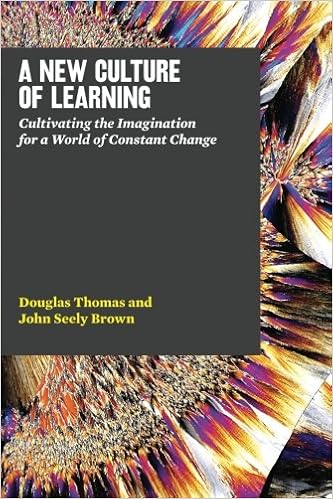
According to Thomas and Brown (2011), two fundamental characteristics produce deep and meaningful learning.
- “Ubiquitous Access” (Dwayne Harapnuik, 2015) is the result of “a massive information network that provides almost unlimited access and resources to learn about anything” (Thomas & Brown, 2011, p. 19).
- A learning Environment is a carefully constructed “bounded and structured environment that allows for unlimited agency to build and experiment,” assists in guiding learners through this new culture, and empowers them to take control of their learning “within those boundaries” (Thomas & Brown, 2011, p. 19).
What kind of culture?

When thinking about a new culture, some might be picturing a process of cultural assimilation. In this new culture, an individual leaves a home country to live in another, quickly finding themselves surrounded by new experiences, opportunities, and situations. The individual will struggle with becoming a part of the new culture, or they will adapt and incorporate the norms and customs of the new culture (Thomas & Brown, 2011, p. 36). According to Thomas and Brown, in this situation, “the culture is the environment” (Thomas & Brown, 2011, p. 37).
The new culture forming out of the digital age is a different culture. Think back to experiments conducted in high school where a container gets swabbed with a sample that is often too small to be seen by the naked eye. However, if the environment is right, growth will begin and can be visibly seen after some time. In this situation, “… the entire point of the experiment is to allow the culture to reproduce in an uninhibited, completely organic way, within the constraints of medium and environment – and then see what happens” (Thomas & Brown, 2011, p. 37). In this context, the culture flourishes due to the environment (Thomas & Brown, 2011, p. 37).

Therefore, to create a new culture of advising, we must set up the environment in such a way that students have the freedom to explore the tips, resources, and information we prepare in their way, at their own pace (Christensen, et al., 2011). At the same time, seeking additional sources of verification material. We must consider how the education system requires a revolution to do this effectively.
Claim: We can transform education, starting with a new culture of advising.
How do we transform education?
Fast-Food, Industrial, Mechanical Model of Education
Sir Ken Robinson argues for a change in education from the current system “based on linearity and conformity and batching people (TED, 2010, 13:26). The authors of the New Culture of agree that this old model views learning “as a series of steps to be mastered, as if students [are] being taught how to operate a machine or even, in some cases, as if the students themselves [are] machines being programmed to accomplish tasks” (Thomas & Brown, 2011, p. 35).


Agricultural, Cultivation, Organic Model of Education
Sir Ken Robinson encourages that “we recognize that human flourishing is not a mechanical process; it’s an organic process, and you cannot predict the outcome of human development” (TED, 2010, 13:50). Thomas and Brown (2011) support this agricultural analogy by explaining how “a farmer […] takes the nearly unlimited resources of sunlight, wind, water, earth, and biology and consolidates them into the bounded and structured environment of a garden or farm” (Thomas & Brown, 2011, p. 19). In the new learning culture, we are “cultivating minds instead of plants” (Thomas & Brown, 2011, p. 19).
Claim: There is a better approach to the new culture of advising.
Which approach will we use?
Teaching-Based Approach
The current model of education “… [focuses] on teaching [students] about the world” by relegating source material, then the students are tested to assess their retention of the information to “prove that they have received the information transferred to them” (Thomas & Brown, 2011, p. 38). This teaching-based approach depends upon a system of static information that is unequivocally reliable (Thomas & Brown, 2011, p.40).
Similarly, in advising, we currently attempt to transfer everything a student will need to know about their academic journey through linked websites and email correspondence. Students receive information throughout their academic journey, but the actions required may not need to be executed until the end of their program sequence. This teaching-based approach presumes the advisor is the expert. Therefore, the student waits to be notified or alerted when there is a significant requirement for them to meet. Unfortunately, with multiple programs and individual paths, advisors must rely upon students’ understanding of program requirements and deadlines. The advisors provide the resources for students’ review. In advising, the assessment equivalent comes when they meet those required deadlines and documents.
Learning-Based Approach
However, “in a world where things are constantly changing, focusing exclusively on the explicit dimension is no longer a viable model for education” (Thomas & Brown, 2011, p. 76). Education must shift to a learning-based approach where the learner must reflect upon what they know, what they need to know, and what they do not know to go out and seek that information actively. This approach to learning requires an ongoing process of “[coming] up with better questions about [what we do not know] and continue asking those questions in order to learn more and more, both incrementally and exponentially” (Thomas & Brown, 2011, p. 38).
To create a new culture of advising, we must find creative ways to inspire student motivation as our students accept an active role in their educational journey. In a learning-based approach, we “… [learn] through engagement within the world” (Thomas & Brown, 2011, p. 38). Therefore adopting this approach as we create a new culture of advising allows students the freedom to seek various sources of information about their chosen path, profession, and personal passions. Additionally, this approach enables students to be more aware of the bigger picture and of how they fit into the world.
Claim: A new culture of advising can increase student motivation.
How do we inspire motivation?
Daniel Pink points to intrinsic motivators like “autonomy, mastery, and purpose” to create motivation in the twenty-first century (RSA, 2010). He points out that people cannot find motivation if they do not have a sense of purpose for “why [they are] doing [something] …, why it even [matters], why [it is] significant” (Crucial Learning, 2013, 14:40).
Through a new culture of advising, we can ask students to answer a series of questions that help them engage with their reasons for the academic path they have selected. We can associate these whys with individual student profiles. Throughout the student’s journey, we can help to remind them and invite them into a process of constant reevaluation of those personal passions to keep them engaged with their purpose.
“When we think about engaging the passion of the learner, we need to think about her sense of indwelling, because that is her greatest source of inspiration, but it is also the largest reservoir she has of tacit knowledge”
(Thomas & Brown, 2011, p. 85).
Students can choose how, when, and what they want to learn at any given point in the new culture of advising, which necessitates 24-hour access to advising information. As the advisor sets goals and provides feedback, the student will gain a sense of mastery. Most importantly, through this new culture of advising, we can guide students through the process of “[creating] something personally meaningful” (Thomas & Brown, 2011, p. 31).
“The new culture of learning gives us the freedom to make the general personal and then share our personal experience in a way that, in turn, adds to the general flow of knowledge”
(Thomas & Brown, 2011, p. 31).
Claim: A new culture of advising will increase student engagement.
How do we increase engagement?
The Collective
According to Thomas and Brown (2011), the new learning culture creates a phenomenon as people gather around similar interests and goals. This actively engaged “… collection of people, skills, and talent … produces a result greater than the sum of its parts” (Thomas & Brown, 2011, p. 52). Within these collectives, “people are free to move in and out of the group at various times for various reasons, and their participation may vary based on topic, interest, experience, or need” (Thomas & Brown, 2011, p. 53). The group that forms “[interacts] and [participates] with one another in fluid relationships that are the result of shared interests and opportunity” (Thomas & Brown, 2011, p. 50).
In a new culture of advising, we can transition the focus from a single advisor that attempts to inform hundreds of students to a collective. Switching supports from the advisor to other peer based learning groups where the student benefits from “a nearly infinite set of resources that any individual can selectively tap into and participate in as part of his or her own identity” (Thomas & Brown, 2011, p. 59).
“We believe that this new culture of learning can augment learning in nearly every facet of education and every stage of life”
(Thomas & Brown, 2011, p. 18).
Claim: A new culture of advising empowers student ownership, through lifelong learning.

What is Arc-of-life Learning?
As time passes, “learning in an age of constant change simply never stops” (Thomas & Brown, 2011, p. 73). “Ubiquitous access” (Dwayne Harapnuik, 2015) connects learners from every country with various passions to seek advanced degrees based on intrinsic motivations to advance their academic knowledge. Blending the “personal and the collective is a key ingredient in lifelong learning” (Thomas & Brown, 2011, p. 72).
A new culture of advising can help create an environment that allows students to connect with individual passions and one another in novel and entertaining ways. According to Thomas and Brown (2011), this type of “play, questioning, and … imagination [lies] at the very heart of arc-of-life learning” (p. 19).
To dig deeper into the new culture and lifelong learning, Thomas and Brown (2011) explore concepts of “tacit learning,” the process of “inquiry,” individual “dispositions,” and the concept of “indwelling” (Thomas & Brown, 2011). The authors’ exploration of these topics provides helpful questions to consider as we create a new culture of advising.
What is tacit knowledge or tacit learning?
Tacit knowledge “can’t be articulated directly in words” (TEDx Talks, 2015). Through learners’ personal experiences, they will have inclinations not taught in any formalized way. This knowledge comes from an accumulation of past trial and error opportunities. Tacit learning presents learners with “the right kind of problems” to “engage in rational thinking” within learning environments with “appropriate stimuli” (TEDx Talks, 2015).
A new culture of learning acknowledges that tacit learning “is not transferrable” (Thomas & Brown, 2011, p. 77) but instead that “in the digital world, we learn by doing, watching, and experiencing” (Thomas & Brown, 2011, p. 76). Therefore, any innovation to advising must facilitate students’ interaction with departments, industry professionals, other learners, online forums, and/or other communities while providing a cacophony of outlets for exploration within the advising relationship.
What does learning as inquiry mean?
Within a new culture of advising, students will make profound and meaningful connections while asking questions and seeking answers since “every answer serves as a starting point, not an endpoint … [inviting learners] to ask more and better questions” (Thomas & Brown, 2011, p. 82). Within this new culture of advising, students learn to trust their instincts within a safe environment where “students learn best [following] … passion and [operating] within the constraints of a bounded environment” (Thomas & Brown, 2011, p. 79).
“What if… questions [are] more important than answers”
(Thomas & Brown, 2011, p. 81)?
What is indwelling?
According to Thomas & Brown (2011), “indwelling is the set of practices we use to develop to find and make connections amount the tacit dimension of things” (Thomas & Brown, 2011, p. 85). Through a new culture of advising, students can experience a “familiarity with ideas, practices, and processes that are so engrained they become second nature” (Thomas & Brown, 2011, p. 84). “Giving students ownership of their learning is far more successful when they are engaged and have agency using the content and tools at their disposal” (Powell et al., 2015, p. 18). Looking to the future of advising, we can help create learners who become indigenous to their learning environment. The learners who benefit from a new culture of advising will be so rooted in their learning journey that it becomes a part of who they are.
“The ability to organize, connect, and make sense of things is a skill characteristic of a deep engagement with the tacit and the process of indwelling”
(Thomas & Brown, 2011, p. 98).
How do dispositions contribute to learning?
Thomas and Brown (2011) use the gamer disposition as an example of “how [learners] are likely to learn” (p. 86) in the new culture of learning. They explain that gamers in massively multiplayer online environments tend to self-assess for the benefit of personal improvement, appreciate the diversity of individual contributions, and challenge the status quo (Thomas & Brown, 2011). Individuals with this outlook embrace learning as a challenge, accept failure, and take more calculated risks than others without this disposition (Thomas & Brown). The goal of a new culture of advising is to create this type of environment so that learners adopt this disposition and help direct the learning of their cohort.
The authors of A New Culture of Learning propose “three different, yet overlapping, frames for redesigning [our education systems]” (Thomas & Brown, 2011, p. 90). By exploring these facets of humanity, we can identify and evaluate the opportunities that present advisors with opportunities to facilitate student learning.
Three Dimensions of Learning

homo sapiens: knowing
“humans who know”
home faber: making
“humans who make (things)”
home faber: playing
“humans who play”
(Thomas & Brown, 2011, p. 90)
Knowing (the where)
Advising sits nicely in the “[new culture of learning where] … knowledge is becoming… more of a “where is the information?” question (Thomas & Brown, 2011, p. 91). As such, one of the strongest values advising brings to the learning journey is the ability to guide students on where to find information. Advisors do not have to memorize every university policy, nor do they execute every procedure of the institution. Instead, advisors know where to locate policies and whom to contact about many procedures. As today’s learners seek information, they also evaluate the source and context of that information before assigning value to it. As stated by Thomas and Brown (2011), “only by understanding the where of a piece of information can we understand its meaning” (Thomas & Brown, 2011, p. 93).
Making and Play (the how)
“The process of making and remaking context is, in itself, an act of imaginative play” (Thomas & Brown, 2011, p. 96). Mitch Resnick (2014) defines “play as an attitude and an approach for engaging with the world,” while “taking risks, trying new things, and testing boundaries.” Thomas and Brown (2011) say that “…play reveals a structure of learning that is radically different from the one that most schools or other form learning environments provide, and which is well suited to the notions of a world in constant flux” (Thomas & Brown, 2011, p. 96).
It may seem challenging to imagine an advising system that encourages playful experimentation; nonetheless, it is the environment we create that can establish the tone of questioning and inquisitivism (Harapnuik, n.d.), which is needed to inspire learners to accept and embrace this new culture of advising.
Notion of Expertise
Thomas and Brown (2011) explain that “in the new information economy, expertise is less about having a stockpile of information or facts at one’s disposal and increasingly about knowing how to find and evaluate information on a given topic” (Thomas & Brown, 2011, p. 93). Freedom from the idea of expertise is one of the most exciting aspects of the new advising culture. It eliminates the expectation that advisors be experts in every aspect of the student’s academic experience. Recognizing that lifelong learning is happening around us always helps release the expectation of expertise and fosters collaborative exploration and critical evaluation of available information (Thomas & Brown, 2011). This freedom allows “… academic advisors [to] move from telling students what courses they need to graduate to helping them dream, grow, and become citizens” (Shockley-Zalabak, 2011, p. 14). This enrichment of the advising relationship evolves it from someone who spoon-feeds information and “[shifts], from answering questions to asking them” (Thomas & Brown, 2011, p. 85).
Challenges
Even though some may assume that this is just another attempt to incorporate technology into advising, it is, in fact, “not about the technology itself; it’s about the shift in instructional model to personalized, student-centered learning to ensure each student’s success” (Powell et al., 2015, p. 17). This opportunity to innovate advising by creating a learning environment (the new culture of advising) that allows 24-hour access to advisors’ resources is needed to meet the demands of today’s learners.
Currently, advisors absorb students’ frustrations about financial aid and other academic issues that are outside their area of knowledge or access. Empowering students to seek and confirm information for themselves will improve interpersonal communication and allow for more meaningful advising interactions. This new advising environment will help solve the issue of student frustrations about missing essential program requirements. As an added bonus, the new culture of advising will strengthen relationships by intentionally designing the learning environment to help resolve students’ confusion about the university’s communication structure by clearly defining the advising relationship and services.
Even still, others may argue that universities are resistant to embracing change. We can and we must embrace the rapidly changing world around us and meet our learners’ needs, or they will find somewhere else that does.
Impact
“Advisors are central to retention and to student development” (Shockley-Zalabak, 2011, p. 16). Therefore, a new advising culture will help the university’s retention efforts. As students work with their advisors in the new culture, students will reflect on their reasons for seeking the degree or certificate, the associated requirements, and their long-term aspirations. Through the new culture of advising, students will have a more solid foundation for their journey. Additionally, creating an environment that promotes learning in a collective provides for both student agency and a built-in support system. Lastly, as advisors and students build strong relationships, removing transactional components, and we will see improvements in customer (students) and employee (advisors) satisfaction through more meaningful interactions.
Conclusion
The key to this new learning culture is that learners follow their passion. The best way to create that climate is to model the behavior in my interactions. Sharing this learning journey (the struggles and failures) illustrates that everyone may inevitably face challenges as life happens. However, what we do when those issues arise and how we grow and learn from them allows us to continue becoming better people who can help change the world. Utilizing the information shared in A New Culture of Learning, one can see the benefits of a self-directed advising resource that creates an environment for learning. Activating our learners’ desire to ask questions, to know how and where to seek information, and tap into “[their] motivation to learn [by providing] a set of constraints that make learning meaningful” (Thomas & Brown, 2011, p. 83). Through the intentional use of this new culture of advising, our students will be more prepared for their program requirements and experience fewer delays in their academic progress. Students will experience greater engagement in the learning process by accepting ownership of the academic journey, which will holistically improve the student body’s experience. Ultimately, we will see higher graduation numbers due to these efforts.
References
Christensen C. M., Horn M. B., Soares L., & L. Caldera. (2011). Disrupting college: How disruptive innovation can deliver quality and affordability to postsecondary education. http://www.americanprogress.org/issues/labor/report/2011/02/08/9034/disrupting- college/
Crucial Learning. (2013, October 1). Purpose—Why We Do What We Do | Daniel Pink. [Video]. YouTube. https://www.youtube.com/watch?v=_p4esMj2EC8
Dwayne Harapnuik. (2015, May 9). Creating Significant Learning Environments (CSLE) [Video]. YouTube. https://www.youtube.com/watch?v=eZ-c7rz7eT4
Harapnuik, D. (n.d.). Inquisitivism. It’s About Learning. https://www.harapnuik.org/?page_id=104
Powell, A., Watson J., Staley P., Patrick, S., Horn, M., Fetzer, L., Hibbard, L., Oglesby, J., Verma, S. (2015). Blended learning: The evolution of online and face-to-face education from 2008-2015. Promising practices in blended and online learning series. International Association for K-12 Online Learning. Retrieved from https://eric.ed.gov/?id=ED560788
Resnick, M. (2014, August). Give P’s a chance: Projects, peers, passion, play. In Constructionism and creativity: Proceedings of the third international constructionism conference. Austrian computer society, Vienna (pp. 13-20).
RSA. (2010, April 1). RSA ANIMATE: Drive: The surprising truth about what motivates us [Video]. YouTube. https://www.youtube.com/watch?v=u6XAPnuFjJc
Shockley-Zalabak, P. (2012). Advisors as interaction designers. NACADA Journal, 32(1), 12-17.
TED. (2010, May 24). Bring on the learning revolution! | Sir Ken Robinson [Video]. YouTube. https://www.youtube.com/watch?v=r9LelXa3U_I
TEDx Talks. (2015, October 15). Importance of Tacit Knowledge in Education | Richard Brock | TEDxCambridgeUniversity [Video]. YouTube. https://www.youtube.com/watch?v=Hkd-1zc_Gn4
Thomas, D., & Brown, J. S. (2011). A New Culture of Learning: Cultivating the Imagination for a World of Constant Change (1st ed.). CreateSpace Independent Publishing Platform.
 The Advisor That Cares