
The Why
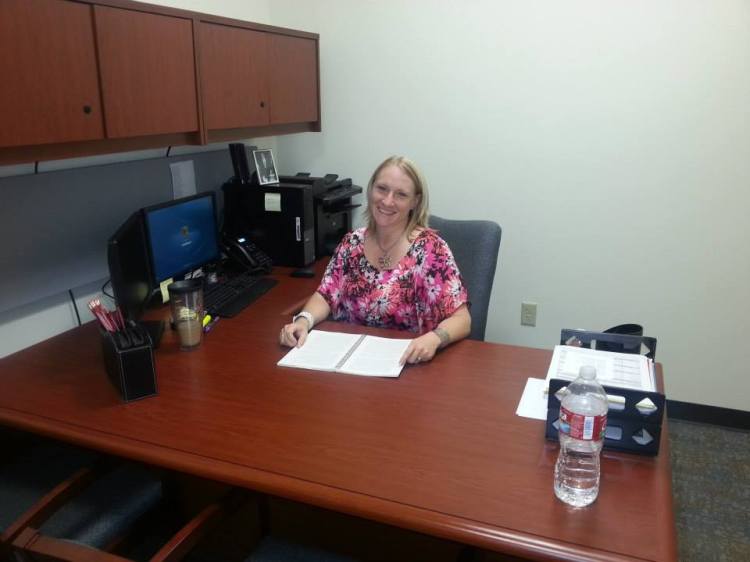
My story began in 2013 when I started my academic advising career. Leaving an eighteen-year career in the medical field, I remember feeling nervous as I stepped out of my comfort zone into this new world of higher education. I combined my experience as an undergraduate student and my years of medical advocacy to find personal fulfillment in my advising role. I followed my students long beyond their time with me and built relationships across campus. I have seen this level of caring and compassion throughout my university time. This truly is a profession dedicated to reaching students to help them succeed.
Advisors inform students of the university resources and support services while encouraging them to fight the human tendency to struggle in silence. We teach students where to find information and how to find their voices so they can ask for clarification and support when needed. As an advisor, I encourage my students to verify everything themselves and take no one’s word as a fact as they progress through college and life.
Advisors assist students through nervous admission, personal turmoil, and academic challenges. Our role can be a repetitive cycle of registration periods, drop periods, and everything related to those processes. Sadly, we can become the directory, search engine, and operator for many of our students. We are the messenger of every policy, the knower of every rule, and the guide for each program. I know too well the demoralizing frustration of constantly saying the same thing day after day.
Innovation to Advising
This advising innovation was born from a desire to help students and my fellow advisors. To provide relief for many of the most monotonous aspects of the job. This solution incorporates blended learning into advising interactions to relieve the information transfer aspects of advising while creating more time and space for truly transformative relationships with students.
We will need training and development as we launch this new tool for the advising toolbox. The learning curve for this innovation idea may initially cause advisors to cling to the comfort of the familiar. But with a clear professional learning plan, we can ensure the implementation and success of our efforts.
Reflecting on the 5 Principles of Professional Learning, I cannot help but recognize the irony of expecting students to absorb everything we download into them during advising appointments or outreach emails when that process needs to acknowledge these same principles.
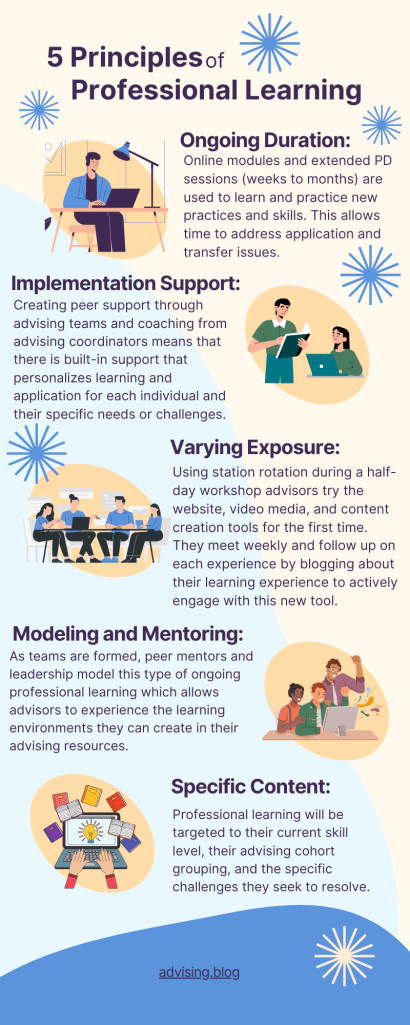
View in Canva
The What
The How
To create my professional learning call to action, I began by thinking about how professional learning is likely different than what we picture when we hear the term. I started free writing. I thought about my innovation proposal and my goal to increase advising availability to students while relieving advisors of numerous transitional interactions through our digitally connected world. I began formulating my thoughts on getting adult learners (advisors) on board to support the innovation of advising. The best way to illustrate the point of our universal connectivity was to get audience participation from the very beginning of my presentation. I thought about Nancy Duarte’s advice about resonating with others and storytelling. I took the advice of Presentation Zen and stepped away from the computer, jotting down notes and sketching out visuals (Reynolds, 2019, p. 47-60). I tried to think about all the different conference sessions I have attended and wondered if I could remember any specific skill or technique I brought back into the workplace. I had an image of a car/airplane ride back home and how little of my professional development was transformative.
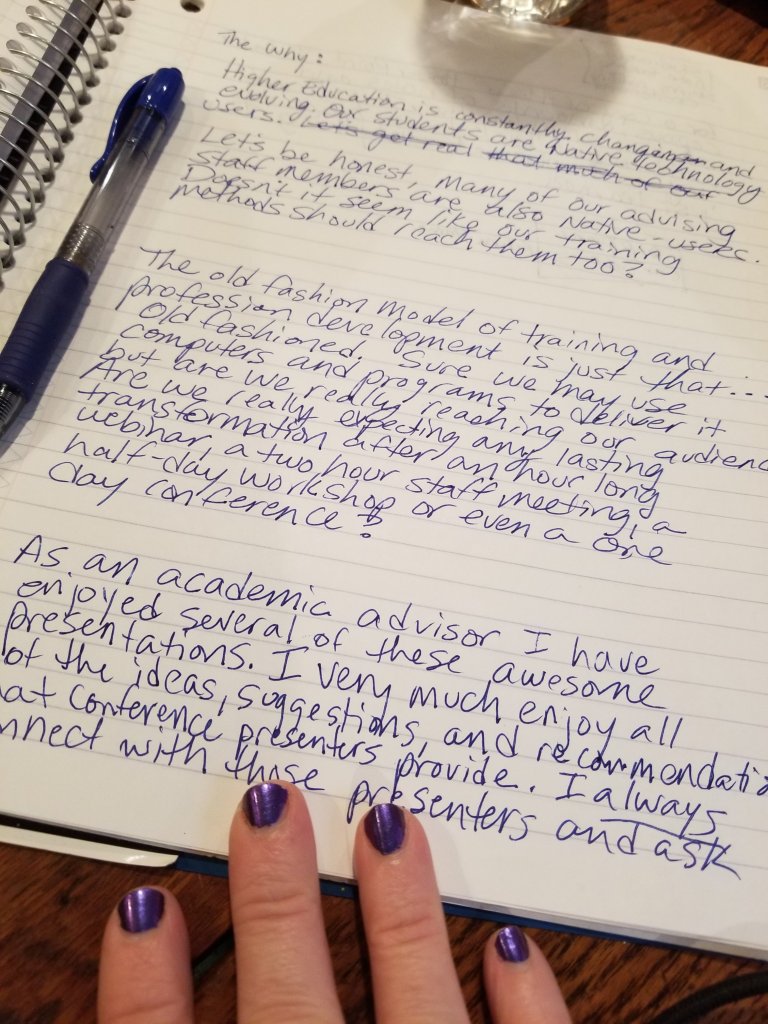
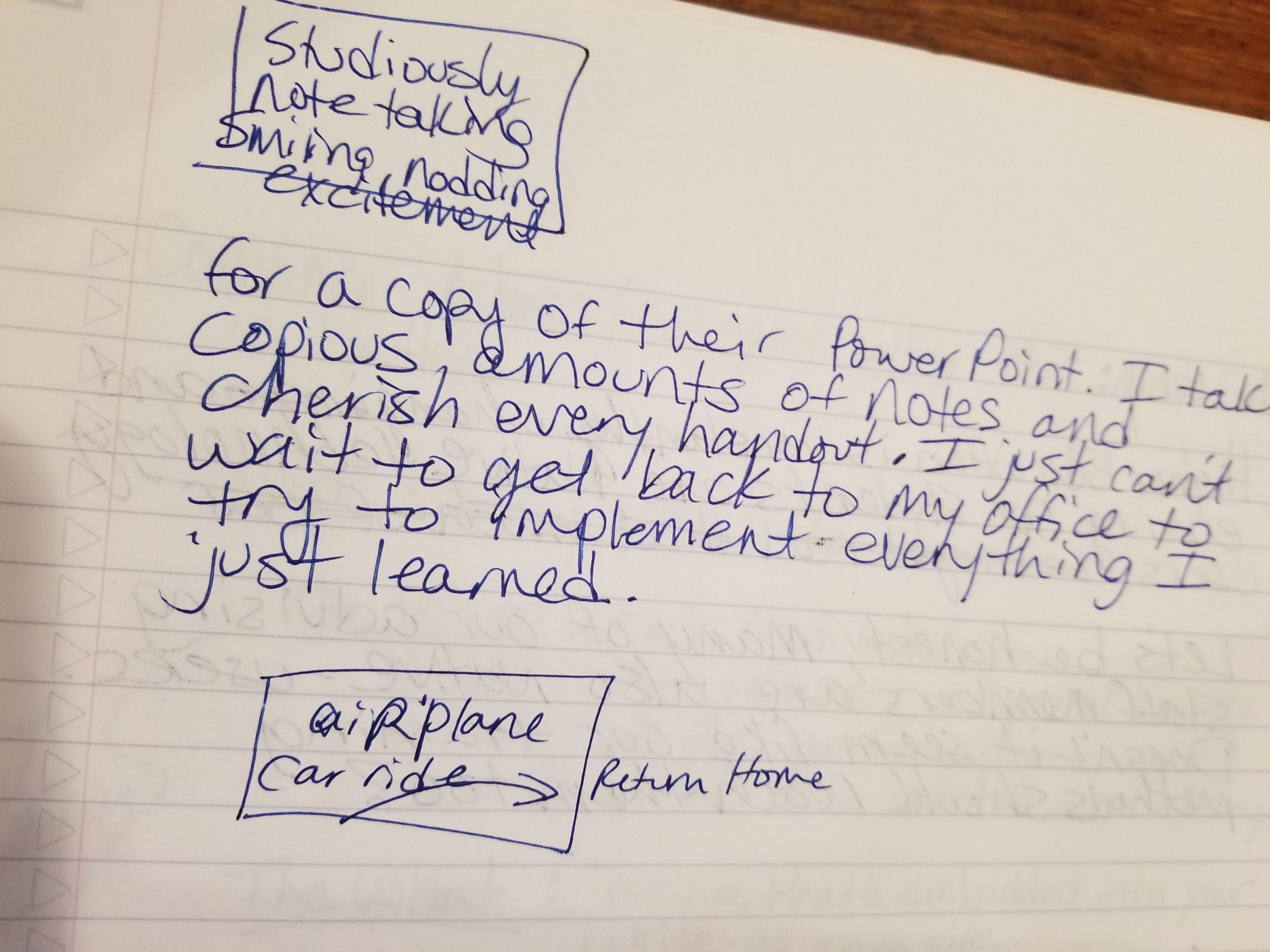

As I began solidifying the message I was trying to convey as I attempted to convince others to join me in a new type of professional learning to accomplish this innovation plan, I turned to Canva.com. Believe it or not (if you have watched the “what” found linked above), my digital creation began here. I applied my brand kit colors and thought I had a decent place from which to build.
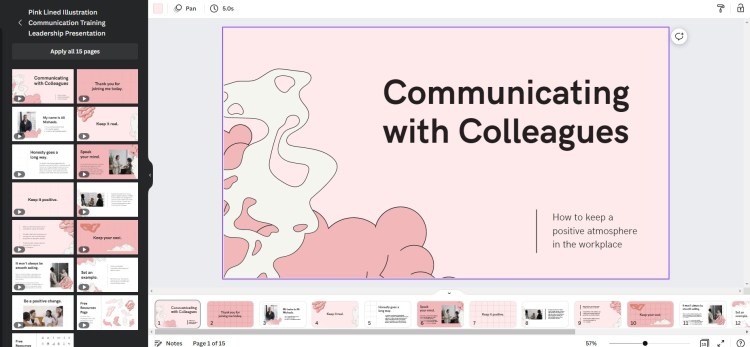

This template, however, had transitions on every page and did not lack decoration. I kept hearing Seth Godin’s advice, “no dissolves, spins, or other transitions” (Reynolds, 2020, p. 21), and Nancy Duarte (2009) telling us to “de-decorate” our presentations (Duarte, Inc., 2009, 2:47), all the while trying to draw the audience into the “new bliss” (TEDx Talks, 2010).

So as tempting as it is to be creative with extra graphics and transitions and flourishes, I am embracing the advice of these expert presenters.

I could not help but realize, as I fought through embedding canva creations and making decisions about form and function on my ePortfolio, the learning opportunity we make as we create our learning environments. We are truly living the COVA approach to learning. I am constantly thinking of ways to make the training and development advisors complete throughout the year, meet their specific needs instead of mine. I do not want to continue the culture of one-and-done training and professional development. I want to embrace professional learning and create a collaborative learning culture so that they each help one another get stronger in the areas where we need support. As I embrace the learner’s mindset and actively engage with new concepts, I see how important it is to create those opportunities for the team. I see how much I want them to have choice, ownership, and voice (Harapnuik et al., 2018) as we build the future for our learners.
Because I am working hard to convey meaning and create a culture, I included a few personal images that help me incorporate Simon Sinek’s recommendations to connect with the audience. This is where most of the motivation behind everything I strive to accomplish is found. I want to connect with the advisors and understand their why and their passions to create learning opportunities that feed their interests and learning needs and help develop them as professionals.
As I review my slide deck after making the recommended adjustments, I am genuinely amazed to recognize how little text is on each page. I removed everything extra and just focused on creating emotion and conveying meaning. I accepted expert advice: “if an image can relay your message, then use it” (Duarte, Inc., 2009, 3:11). I see a more straightforward and clean presentation comparing the starting template to the final product.
Final Product

References
Duarte, Inc. (2009, December 16). Five simple rules for creating world changing presentations [Video]. YouTube. https://www.youtube.com/watch?v=hT9GGmundag
Gulamhussein, A. (2013). Teaching the teachers: Effective professional development in the era of high stakes accountability.
Harapnuik, D., Thibodeaux, T., & Cummings, C. (2018). Choice, Ownership, and Voice through Authentic Learning. Creative Common License.
Life Mentor. (2018, January 10). Simon Sinek – How to present properly(Part 5) [Video]. YouTube. https://www.youtube.com/watch?v=msvmLlAkOno
Reynolds, G. (2019). Presentation Zen: Simple Ideas on Presentation Design and Delivery (Voices That Matter) (3rd ed.). New Riders.
TEDx Talks. (2010, December 10). TEDxEast – Nancy Duarte uncovers common structure of greatest communicators 11/11/2010 [Video]. YouTube. https://www.youtube.com/watch?v=1nYFpuc2Umk
TEDx Talks. (2013, November 6). Empowering the teacher technophobe: Kristin Daniels at TEDxBurnsvilleED [Video]. YouTube. https://www.youtube.com/watch?v=puiNcIFJTCU&feature=youtu.be
TNTP. (2015, August 4). The mirage: Confronting the hard truth about our quest for teacher development. https://tntp.org/publications/view/evaluation-and-development/the-mirage-confronting-the-truth-about-our-quest-for-teacher-development
 The Advisor That Cares