
A New Culture of Learning, ADL Program, Advising, ePortfolios, Focus on the learning, Goals, Influencer, Innovation Plan, It's all about the learning, Leadership, Learner's Mindset, Learning, Outcomes, Personal, Professional, Publication, Reflecting, Relationship

Engaging Media

5317 Discussion 3


EKG - pulse rate display

In the ADL Program, we learn the importance of always focusing on learning. Technology, just for the sake of it, does not revolutionize education. We must be ready to engage in crucial conversations about our innovation ideas to be effective agents of change. To do this effectively, we must work to enact organizational change as we influence others. Acknowledging that our learners come to education from a new learning culture, we must find ways to adapt and reach our learners by creating significant learning environments. With intentional planning, we can present learners with choice, ownership, and voice within an authentic learning environment (COVA).

One of the critical components of becoming a catalyst for change is drawing others into collaborative relationships so that ideas and innovations can continue to grow and evolve with the input and perspective that others bring. Engaging media is one thing that we can employ to ensure that our message reaches those who can contribute. Speakers Mathew Luhn and Nancy Duarte discuss how effectively using media through storytelling can draw the audience into your message (Marwick Marketing, 2017; TEDx Talks, 2010). In my media project, I describe the misery that summer orientation season can bring to the advising profession. I will be the first to admit that in its current format (a long, hot day of walking all over campus and hearing people present to you), it is not an engaging experience. I cannot describe how many students and parents sleep through presentations and content. Hoping to resonate with potential readers of my article, following the advice of Nancy Duarte I paint this picture of the status quo sets the stage for my description of an alternative solution (TEDx Talks, 2010). I hope to draw readers into my article by describing “the new bliss” of what learners and advisors can experience by adding technology to expand the relationship (TEDx Talks, 2010). 

  • Set up:
    • Beginning: Problem. Explain the problem that you set out to solve.
  • Build:
    • Middle: Solution. Describe how you solved it.
  • Payoff:
    • End: Success. Get excited about the success this produced.

(Marwick Marketing, 2017)

  • What is:
    • Beginning: Establish what is, the status quo
    • Compare a drastically different vision of what could be
    • Compare and contrast the status quo and the new idea
  • What Could Be – A Compelling Solution
    • Middle: What is vs. What could be
    • What is vs. What could be
    • What is vs. What could be
  • The New Bliss
    • End: Call to Action

(TEDx Talks, 2010)


References

Marwick Marketing. (2017, May 30). Story telling in business – Pixar story teller Mathew Luhn at CIMC [Video]. YouTube. https://www.youtube.com/watch?v=HYQOW34b-0g

TEDx Talks. (2010, December 10). TEDxEast – Nancy Duarte uncovers common structure of greatest communicators 11/11/2010 [Video]. YouTube. https://www.youtube.com/watch?v=1nYFpuc2Umk


Swing Batter, Batter

Participate in a class discussion in which you begin by addressing the following issues/questions:

  1. Discuss ways that media can engage the audience to influence their thinking?
  2. What have others done to engage you?
  3. How will you incorporate these ideas into your media project?
  4. How would you influence reviewers to read your publication?


One of the critical components of becoming a catalyst for change is drawing others into collaborative relationships so that ideas and innovations can continue to grow and evolve with the input and perspective that others bring. This Resources for Digital Environments course asks us to create a media project to advertise our publication article. Media allows the viewer to increase or decrease the speed of content. As a learner who still takes old-fashioned pen-and-paper notes, I appreciate the ability to back up and replay. The addition of closed captioning has been instrumental in my full understanding and is especially helpful when recording quotations.

Speakers Mathew Luhn and Nancy Duarte discuss how effectively using media through storytelling can draw the audience into your message (Marwick Marketing, 2017; TEDx Talks, 2010). Dr. Harapnuik does an exceptional job of placing questions of inquiry throughout his introduction videos. I always search for Learners Mindset Discussion podcasts on the topics we cover throughout the ADL Program. He has continually taught us about the power of storytelling and drawing your audience into your ideas through active, engaging, personalized learning. In my article, published in sources read by advisors, I reflect on the misery that summer orientation season can be for our profession. I cannot describe how many students and parents sleep through presentations and content. Improving these events through engaging media presents an opportunity to draw them into the event’s purpose, preparing their learner for the upcoming college experience. Mathew Luhn explains that you need to draw people in by creating something unusual, unexpected, or has some sort of action or conflict in the very beginning in [the] first eight seconds” (Marwick Marketing, 2017, 22:30). Nancy Duarte (2010) creates this hook by comparing “the commonplace of the status quo, [… contrasted …] with the loftiness of your idea” (TEDx Talks, 2010, 6:57-7:02). I hope to draw readers into my article by describing “the new bliss” of what learners and advisors can experience by adding technology to expand the relationship (TEDx Talks, 2010).


ADL Program, Advising, ePortfolios, Focus on the learning, Goals, Innovation Plan, It's all about the learning, Leadership, Learner's Mindset, Learning, Personal, Professional, Publication, Reflecting, Relationship, Why

Searching vs. Trying


Cartoon male detective wearing a green jacket and hat, holding a magnifying glass, scratching his head while examining a red question mark.

Thanks to the ADL Program, I love that I am constantly observing my learning behaviors. 

I recently rearranged and connected multiple monitors. I still laugh at how much of this program I completed working on my laptop monitor alone. In my household, there are three adult technology users. My husband and adult daughter are gamers of every variety (board, tabletop, console, PC), and I have dabbled in all of the above, frequently poorly. We have accumulated several longer-used devices.

This morning, my taskbar is not showing on the additional monitors. I am constantly rearranging the monitors due to recording requirements vs. writing requirements. I create homemade teleprompters for digital media presentations, though I still need to find a way to scroll the text while recording. I discovered how to scroll text, but since I’m clicking between windows to advance presentations during recordings, it stops and annoys me! The display setting changes likely resulted in an unintended change or a misfired keyboard shortcut. 

Image of web browser open to web address https://www.google.come with the colorful logo.
Image of red background with white text "You Tube" logo.

Into my handy dandy search engine, I type, “can I extend the menu bar across monitors,” and while executing the search, I decide to go digging through system settings to see if I can find it myself. What do you know? Right there in Personalization > Taskbar is a toggle to do precisely that. I click back over to my results and mentally applaud my learner’s mindset that knows there is a resource I can utilize when needed. Still, I am also a solution-seeking, inquisitive learner who will go tinkering about and seek support as required.

THIS! The learners’ mindset is what I want to help learners discover: their authentic learning opportunities. I want to work with a team of advisors to channel the passions that feed their strengths and abilities. I want to help humanize the relationship of advisors and of students. 

The advisors feel like robots and that what they say isn’t heard and doesn’t seem to matter to many students. TAsked to justify the behavior and decisions of students who did not follow the advising they received or failed to follow the outlined procedures. They are placed into cycles with no finish line or celebration, leading to impending dread as the subsequent avalanche falls to them to manage. 

When stressed out, people are not usually the best version of themselves. Insecurity can express themselves in hurtful and accusatory ways. Learners and their parents often need clarification on rules and regulations. Because learners have yet to learn the terminology used at the university, they will talk to multiple offices and people before getting the necessary information to make timely decisions. Understaffed and overworked humans can make mistakes, which damages relationship building. If we can help learners learn how to learn, they will also seek, verify, and understand well-planned and executed learning outcomes. 

A New Culture of Learning, ADL Program, Advising, ePortfolios, Evolution, Focus on the learning, Goals, Growth, Growth Mindset, Influencer, Innovation Plan, Instructional Design, It's all about the learning, Leadership, Learner's Mindset, Learning, Learning Community, Online Learning, Outcomes, Personal, Professional, Publication, Reflecting, Relationship, Why

Leftovers


Media Project leftovers

Mannn, there’s so much to share. I definitely wanted to include a million quotes and clips in my media project. I will put them all here for now so I can revise and improve my thoughts, my article, and my innovation when I feel less limited by deadlines and time limits.


Quotes with YouTube clips:

This relationship has the potential to guide students through the unfamiliar landscape, and the language of higher education can also equip them with the skills needed to make informed decisions and choices in life. Jim Ott (2016) passionately echos this opportunity by saying that “significant learning comes through relationship” (TEDx Talks, 2016, 12:18-12:20). These connections allow the navigation of experiences, emotions, and the many questions that arise.

Sir Ken Robinson (2010) explains that the 21st-century educational landscape has “an unprecedented demand for innovation, for fresh thinking, fresh social systems, fresh ways of getting people to connect with themselves and have lives with purpose and meaning” (RSA, 2010, 32:37-32:40).

Jon Stolk (2015) says, “choice, trust, acceptance, encouragement, dialogue, care; when students feel these things, there are extremely strong positive correlations to a bunch of the stuff we we say we care about. So things like peer learning and active help seeking this is engaging with others in the learning process. Learners finding more value in what they do. Self-efficacy, the sense that you can be successful. Intrinsic motivation. Creativity. Very high level cognitive engagement, metacognition, thinking about your own thinking process” (TEDx Talks, 2015, 15:17-15:50).

Jim Ott (2016) passionately explains, “so if we are truly interested in the future of our children we must give them significant learning. We must give them a sense that they matter. We must invest in the emotions of now because everything about what we care about, their future, depends on them developing a foundation of believing in themselves. That they have value that they have purpose. That they matter. That is significant learning” (TEDx Talks, 2016, 14:56-15:27)

Craig Mertler (2019) challenges us all “to think about some aspect of your life, that you would like to change. No matter how big or how small. It doesn’t matter if it is personal, professional, academic. It doesn’t matter because you own it. It’s about you and your life. Find a different way of doing this thing and try it out. Gather some evidence of how well it worked for you and then make a plan for where you go next. Is this the solution or do I need to keep looking. Do I need to keep finding better ways to improve?” (TEDx Talks, 2019, 9:43-10:17)

Sir Ken Robinson (2010) “people do their best when they do the thing they love. When they are in their Element” (RSA, 2010, 26:45-26:51).

Sir Ken Robinson (2010) “evidence is persuasive when people get to connect to this powerful sense of talent in themselves, discover what it is they can do, they become somebody else. And that […] me is the premise of building a new education system” (RSA, 2010, 27:03-27:15).

Through discussions and reflections, advisors guide learners through encouraging questions. Working with students to help them understand their why (TEDx Talks, 2019), connect with their goals, and reignite the inquisitive mind. Sugata Mitra (2013) poses that “encouragement seems to be the key […] simply saying wow, saluting learning” (TED, 2013, 13:58-14:10).


Harapnuik, D. (n.d.). CSLE. It’s About Learning. https://www.harapnuik.org/?page_id=849

Horn, M. B., & Staker, H. (2017). Blended: Using disruptive innovation to improve schools. John Wiley & Sons.

Khan, S. (2011, March). Let’s use video to reinvent education [Video]. TED Talks. https://www.ted.com/talks/salman_khan_let_s_use_video_to_reinvent_education?language=en#t-149503

RSA. (2010, February 4). Sir Ken Robinson – changing paradigms [Video]. YouTube. https://www.youtube.com/watch?v=mCbdS4hSa0s

Steele, G. E. (2016). Creating a flipped advising approach. NACADA Clearinghouse of Academic Advising Resources. Retrieved from https://nacada.ksu.edu/Resources/Clearinghouse/View-Articles/Creating-a-Flipped-Advising-Approach.aspx

TEDx Talks. (2009, September 29). Start with why — how great leaders inspire action | Simon Sinek | TEDxPugetSound [Video]. YouTube. Retrieved from https://www.youtube.com/watch?v=u4ZoJKF_VuA

TEDx Talks. (2016, March 14). Significant learning | Jim Ott | TEDxBellevueHighSchool [Video]. YouTube. https://www.youtube.com/watch?v=Zos6lhaehfo

TEDx Talks. (2019, March 20). Personal empowerment through reflection and learning | Dr. Craig Mertler | TEDxLakelandUniversity [Video]. YouTube. https://www.youtube.com/watch?v=uzDsT-25w14

ADL Program, Advising, Collective, ePortfolios, Learner's Mindset, Learning, Learning Community, Online Learning, Tips

Mind Blown!


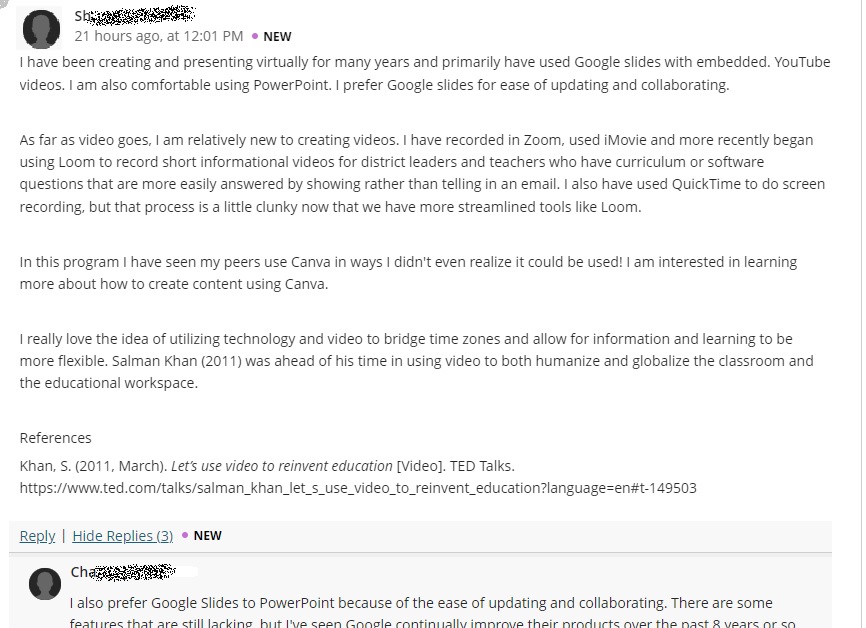
My goodness gracious, my two main collaborators this semester just blew my mind with their statements about how helpful they find Google Slides. I always found them overwhelmingly blank because I am spoiled by the templates found in Canva.

I have never really used Google Slides because every time I open it, the blank starting page overwhelms me, and I find myself abandoning the attempt for places I can start with a designed template I can modify and use as a starting place. Maybe I am just missing out on a feature I have not yet found. Do you all import templates from other sources or design from scratch? [Off to do some searches after catching up on recent discussion posts]

I asked them a question about utilizing Canva with Google slides in a discussion post but our conversations are asynchronous so I head off to my trust research database YouTube.

While these results aren’t what I had in mind when I posed the question, my mind is blown by all of the opportunities to interact with advisees these Google Slides


Okay, okay… I realized I left you hanging there and didn’t point out any research to the original question: There are templates that you can use with Google Slides. Exciting times and opportunities ahead!

ADL Program

Preparing Pitch?


Cartoon drawing of a brown haired smiling man wearing red glasses and a green sweater displaying an oversized clipboard with a stair stepping red arrow trending upwards.

Desperation:

Man! I cannot tell you how much I am missing my tribe. I have been posting and engaging with my classmates, but I’m failing and failing to find my learning collective this semester.

I am so thankful for the couple who are still trying to work out opportunities to collaborate and help each other flesh out our ideas. Now, I’m here facing this requirement to create a podcast or long-form video discussion without all my amazing classmates who just graduated.

Observation:

I’m working through the new content and recognize that there must be some process to regularly check and update links when dealing with digital resources. I am a desperately seeking knowledge and skills kinda gal, so I went and hunted down everything with searches, and I’ll have to share this list with the course content creators because I know they are also passionate about keeping resources updated.

Reservation:

I acknowledge, based on this authentic learning environment, that the nature of the content of this course has, almost by design, asked that I step back from my sounding board and look back inside. What is the passion that ignited this innovation plan? Why would anyone want to follow and explore my thoughts and ideas (in hopes of igniting their own)? How can we create the most impactful learning opportunity for our advisees? What motivates us to do what we do (Simon Sinek’s “Why”)?

This is my opportunity to be completely vulnerable about what I’ve been building in my mind, creating with my heart, and desperately seeking collaboration with like-minded, passionate people (colleagues, campus partners, other university stakeholders, parents, and students). What beautiful communities await to be born as others consider how they could innovate their relationships.

ADL Program, Innovation Plan, Learner's Mindset, Learning, Online Learning, Publication, Reflecting

Digital Tools

5317 Discussion 2


The concept of data-driven analytics and decision-making appeals to me very much. As advisors, we often run from one fire/crisis to another. Stepping into a leadership role in an advising office makes me reflect on the whirlwind discussed during the Four Disciplines of Execution (McChesney & Huling, 2012) in the Organizational Change course (EDLD 5304). It seems there is just never time to reflect on, re-evaluate the effectiveness of, re-group, and collaborate on what is working and what is not. Salman Khan’s dashboard-style data would be valuable if applied to advising topics and discussions and allow feedback and clarity of the materials covered in micro-lecture formats (2011).

I strongly believe that digital learning provides an opportunity to completely shift the nature of the advising relationship and the role peers and community can play in supporting each other’s motivation and success. We can utilize the digital tools at our fingertips and those we have not even imaged yet to create a significant learning environment (advising relationship) out of the significant learning environment (university life). I have enjoyed the value of concise lecture formats when they are effective. I have also benefited from the sometimes vague instructions that leave us wondering when, where, and how we will learn a new skill (for those like me who came to this program without a digital skillset). Canva has been very helpful throughout the creative process by allowing the combination of words and audio, voice and text. Canva offers the ability to utilize the materials in multiple formats which I prefer to post various options for my learners’ preferences to be met. For example, I might use a video I created in Canva, but I will also post the script and slideshow. I understand the value of having multiple formats and the freedom to choose delivery based on my learning preferences and needs. 

Reflecting on the value of video feedback, this is one aspect I had not previously considered bringing into my learning community here in the ADL program, nor into my innovation ideas. I have not received constructive video feedback since my first semester in the program. It helped build a trusted relationship with Dr. H because the real-time review and feed-forward allowed me to visualize clarity issues from another person’s perspective. I never realized how valuable those might be to students in a flipped advising situation. Now I see that real-time reviews and feed-forward messages of encouragement and a growth mindset in times of struggle might be the gentle nudge some students need to explore support options and seek help. 

Reference

Khan, S. (2011, March). Let’s use video to reinvent education [Video]. TED Talks. https://www.ted.com/talks/salman_khan_let_s_use_video_to_reinvent_education?language=en#t-149503

McChesney, C., Covey, S., & Huling, J. (2012). The 4 Disciplines of Execution: Achieving Your Wildly Important Goals (1st ed.). Free Press.


Communicating Ideas

In this next section of content, after selecting journals and developing rough drafts that can be submitted for publication, the next learning outcome is to

  • “… explore and evaluate media resources to assess the most effective way to communicate ideas” (Module 2-6 Outcome/Goal 2).

Participate in a class discussion in which you begin by addressing the following issues/questions:

  • What audio and video applications can you use to help you create powerful presentations or demonstrate your personal learning? What video or audio tool are you already are working with and why? What other tools can you consider?
    • Canva has been very helpful throughout the creative process. Allowing the combination of words and audio, voice and text along with multiple format posting options. I will often use a video but still post the associated slideshow.
    • Vlogs, youtube podcast discussions would be another great way to demonstrate and document personal learning.
  • If you haven’t already done so explore using a screencasting or audio tool to offer feedforward to your peers and learning community. Consider how you can incorporate using screencasting in your instructional setting. Consider the feedforward you have been receiving in this course and review and discuss Feedforward Vs. Feedback post at – http://www.harapnuik.org/?p=8273
    • I have not received constructive video feedback since my first semester in the program. I feel that it helped build a trusted relationship with Dr. H because the real-time review and feed-forward allowed me to visualize clarity issues from another person’s perspective. I have grown to crave the feed-forward the learning community of this ADL program provides. It is very lonely here at the finish line of a non-accelerated path to program completion. I see how and why the bonds between our cohort members were so strong. We valued one another’s honest feed-forward and perspective to help our innovation plans grow. Seeing so many of those classmates still live their innovation is exciting.
    • I never realized how valuable those might be to students in a flipped advising situation. I understood the value of having multiple formats and the freedom to choose delivery. Still, now I see that real-time reviews and feed forward messages of encouragement and a growth mindset in times of struggle might be the gentle nudge some students need to explore support options and seek help.
ADL Program, Advising, It's all about the learning, Online Learning, Professional Learning, Publication, Research, Tips

Always timely, EDUCAUSE


While written with IT Leaders in mind, innovative educators and support staff can benefit from these 10 Calls to Action for the Future of Technology in Higher Ed.

  • #1 – Collaboration
    • “Regular, reliable, and repeatable interactions with customers can also lead to greater customer satisfaction, productivity, and efficiency, along with a deeper appreciation of humans working together” (Gonick, 2023).
    • “A key question arises: how can their organizations be prepared to make necessary pivots to solve systemic challenges? Doing so starts with a theory of change—one with a vision and a strategy to engage people and to develop agile organizational capacity. The tools and technology will follow” (Gonick, 2023).
      • This point immediately makes me consider the ADL program’s Influencer and 4DX change strategies.
  • # 2 – Belonging
    • “Belonging is an outcome that’s hard to measure, but we know when people stay engaged, it’s because they feel they’re somewhere worthwhile—and that they’re someone worthwhile. Belonging is an ethical expression of solidarity and in opposition to the dominant experience of alienation” (Gonick, 2023).
      • This is a crucial component of my innovation and an excellent spot to highlight how creating a learning environment that supports the advising relationship could help students and employees gain this sense of belonging and significance.
  • #3 – Learning at Scale and AI
    • “The best of AI in the higher education setting lies in its potential to revolutionize how learners access and engage with educational resources, offering personalized experiences at scale” (Gonick, 2023).
    • “AI has the power to transform how colleges and universities provide services, support vulnerable populations, improve STEM education, and much more” (Gonick, 2023).
      • Incorporating AI into the innovation to advising would make for real-time student support anytime a student faces a situation, has a question, or expresses a challenge. This opportunity poses many future possibilities for the advising relationship.
  • #4 – Analytics of Support
    • “Data helps us understand how to provide better support to students and learners; being able to provide just the right interventions at just the right moments can be the difference between someone dropping out and feeling they have the resources needed to continue and thrive” (Gonick, 2023).
    • The future of advising could potentially include “… using real-time analytics and smart technology to identify patterns in students’ learning and providing personalized recommendations for support and intervention” (Gonick, 2023).
      • Isn’t proactive advising with on-time intrusive intervention a goal for forming a robust and trusted advising relationship? Shouldn’t helping students obtain the tools they need to be successful and to excel in their chose degree program a big piece part of our goals in higher education?
  • #5 – Identity Management
    • “… using digital resources to ensure a seamless learning journey—such as by using extended reality and adaptive technologies to enhance learning strategies. This approach has the potential to transform academia and equip students with the skills and knowledge they need to succeed in today’s rapidly evolving landscape (Gonick, 2023).
  • #6 – 10 coming soon (I fell down a rabbit hole of research again when I need to be writing.)
    • “Narrative-based learning is very different from the industrial models that have guided instruction at scale for nearly a century. We will need to get better at understanding how to construct compelling narratives that invite learners to chart their own learning journeys” (Gonick, 2023).

Reference

Gonick, L. (2023, August 29). 10 calls to action for the future of technology in higher ed. EDUCAUSE Review. https://er.educause.edu/articles/2023/8/10-calls-to-action-for-the-future-of-technology-in-higher-ed?utm_source=Selligent&utm_medium=email&utm_campaign=er_content_alert_newsletter&utm_content=9-06-23&utm_term=_&m_i=uxOFDaW%2BUx81Tdgqy3EtRPi%2B9T04jmwuyU5EK1X_ilZ0JLfk3kCH9WgfIrKaaoiaQz2dWaXjVjUlZl0oy2FW3egvsGqMHieuup&M_BT=88967532832

ADL Program, Advising, Contributions, ePortfolios, Focus on the learning, Goals, Growth, Innovation Plan, Instructional Design, It's all about the learning, Learner's Mindset, Learning, Online Learning, Outcomes, Personal, Professional, Publication, Why

What to Write


Going through Dr. Harapnuik’s content and nearing the end of the ADL program makes many connections between the strategies and learning accomplished throughout this authentic learning environment.

I cannot help but reflect on my personal why (TEDx Talks, 2009). My passion is caring about other people. My goal is to make a difference and to try and make things better for those around me. Caring about others drives me to make a difference for frustrated students and advisors.

Advisors have an opportunity to embrace innovation in the ways that we approach our advising relationships. Think about ways to turn the repetitive parts of your job (the unrewarding information transfer topics and system onboarding done with students) into question-based searchable resources. What if posing questions and teaching students where and how to find information is far more valuable than trying to be the holder of all knowledge, policy, and departmental preferences.

My vision is that advisors and students will collaborate to create resources and communities that support and encourage one another as advisors step into mentorship roles and learners find peer support and guidance. Guiding learners to explore their goals and questioning what challenges or obstacles might hold them back allows learners and advisors to discuss and problem-solve unique concerns and considerations at individualized levels. Advisors serve as guides or coaches while students research advising resources, university websites, and support services relevant to their issues and concerns. Learners embrace ever-increasing efficacy over their learning experience through reflection blogs, cohort discussions, and peer meet-up opportunities (in person and virtual).


TEDx Talks. (2009, September 29). Start with why — how great leaders inspire action | Simon Sinek | TEDxPugetSound [Video]. YouTube. Retrieved from https://www.youtube.com/watch?v=u4ZoJKF_VuA

ADL Program, Publication

Schank you very much


Well darn. How in the world am I just now learning about Roger Schank! A link was thrown into the publication assignment, and I was off exploring another rabbit trail.


Cognitive processes

Roger Schank on Invisible Learning

Teaching Minds: How Cognitive Science Can Save Our Schools (slightly modified cognitive process labels/titles)

Alternative Learning Place


Innovation Playlist (2007)


All the connections are coming together.