
This clip addresses the importance of failure as key to personal development.
Language and other warnings should you choose to watch the full video, I clipped to relevance.
This clip addresses the importance of failure as key to personal development.
Language and other warnings should you choose to watch the full video, I clipped to relevance.
This clip accurately describes the same opportunities we can help prevent our learners if we create a significant learning environment and give them authentic learning opportunities with life long outcomes in mind.
Language and other warnings should you choose to watch the full video, I clipped to relevance.
Somebody pinch me. I must be dreaming!
I have spent hours and hours watching Learner’s Mindset Discussions. Never would I ever have dreamed I would be in one! What a dream come true to sit and visit with two inspirational educators.
You have to believe it.
Leaning into the learners’ mindset, I have to ask myself daily to believe and trust it.
I have been entirely transparent about my writing struggles. I voiced in class that I need more confidence in my understanding of the subject matter to give my analysis and knowledge of other authors’ statements and research. This lack of confidence sends me back to the research reading and collecting more information, sources, and additional research. I can cite sources all day, but when I have to draw connections between material and express my understanding, I trigger memories of my K-12 educational experience and lose confidence. Research can become my distraction technique (an observation grad school has illuminated) to avoid the vulnerability that is academic writing.
Since I have reviewed hundreds of pieces of literature on my innovation topic formally over the last year and four months but professionally for the previous nine years and ten months, this topic is truly a passion project of the heart. Born out of desperation to help students, the advocate in me also desperately wants this tool for advisors. We are in tear-filled meetings over a crisis of self-issues. Advisors watch the battle young adults face with themselves over your disappointment if they decide whether or not they are pursuing their goals and dreams or yours.
I desperately want advising to be about the transformative development I read about in the literature. I felt disappointed after my first literature review as I recognized I was not meeting the goals and standards set by my profession. I now see that I am efficient at prescriptive advising. From a medical professional background, procedural information transfer, triaging issues, and answering questions came naturally. I know how to connect students to policy and procedures. I efficiently direct them to their departmental information on degree plans and course information. I am helpful and efficient at answering questions with source links (because advisors are only as good as the accuracy of the published information). I have always had an efficiency perspective. Therefore, I formalized my advising process, communications, and documentation for record keeping.
An advising course provides advisors and students a voice to illuminate problems faced by learners as expressed through cohort/meta-major discussions and assessments. Advisors could improve resources with an advising course, grade book, discussion boards, collaborative group sessions, and modules on common issues. Flipped advising would allow that effort to improve even further through media and collaboration with an advising team. I suspect turnover is both from burnout and demoralization. Advising is a passion profession. Many interview questions touch on helping people achieve their goals. Yet it can become a repetitive process of covering the same policies, procedures, and systems instead of all the things it could be if these items didn’t consume advising interactions. The ability to extend the advising sessions and depth beyond a 30-minute advising appointment twice a semester (optimistically). How can we help transform learners’ lives in 1 hour a term? Flipped advising would help us meet those needs while also relieving us of so many of the repetitive interactions we have day after day. Those fulfilling aspects of developmental advising forge a bond between advisor and advisee. Those connections are the ones that make commencement so special and a commitment to this profession so worth it.
Advisors consistently wonder if their efforts improved outcomes, but the cyclical and reactive nature of the industry can have us moving on to the next initiative with no feedback on the last one. Smiling faces that thank you for supporting them while wearing caps and gowns sure go a long way in motivating outcomes and innovations.
So now, I need to support all those beliefs with evidence from the existing literature.
By golly, I think I understand the point of a literature review finally.
Calling all paraphrasing pros!
First, I am looking for all of your tips and techniques for effective review of literature (literally, how you take notes while reviewing it).
Second, what is your method for synthesizing the information without stating someone else’s idea as your own?
I am desperate to improve in these areas.

I greatly appreciate Dr. Meeuwse holding office hours. This has rejuvenized the collaborative aspect of learning that I enjoy (and miss) so very much. I love that we have a facilitator who genuinely wants to help us be successful in our writing. I have picked up some great tips for approaching this literature review. I already feel more comfortable and familiar with the content of my research. I still really struggle to articulate how I believe my innovation plans are innovative and are the first of many steps toward a better experience for students and advisors.
Last week, Dr. Meeuwse shared a tip on her research approach during her doctoral experience.
She gave a beautiful nugget of knowledge when she suggested we approach paraphrasing by making bullet points of no more than two words (citing the source as we go) while reviewing relevant literature.
Tonight she gave additional details.
Read the article through, read it aloud, making bullet points with in-text citations, then put it away (the source material). Go and write sentences from memory (trying not to return to the source material so you aren’t tempted to reuse the authors’ words or meanings instead of expressing your learning).

This program’s craftsmanship never ceases to amaze me. I have a very specific visual image in my head of Dr. Harapnuik telling us how sneakily he manipulates us into learning.
Embarking on this course, I really had to give myself a pep talk. I dreaded whichever class had another one of those dang lit reviews. I forced myself to reflect as those old patterns of panic tried to creep in. Almost immediately, I recognized that I had to own whether or not I had embraced and accepted a learner’s mindset. Would I let research and academic writing scare me away from the authentic work I have been doing throughout this program to bring flipped advising to life?
Looking at the work I have completed up to this point in the program made me recognize that I am very familiar with my innovation plan. I am approaching my research efforts with much more specificity than my first attempt at a literature review. I definitely have a better understanding of the point of the darn thing. I am still struggling to explain what I hope to do with flipped advising and how students accurately identifying coursework for registration is the first significant step forward for our advisors and students.
Nonetheless, by standing on multiple means of support found in the literature, I will have a clearer picture of exactly how action research will guide the process toward revolutionizing advising.
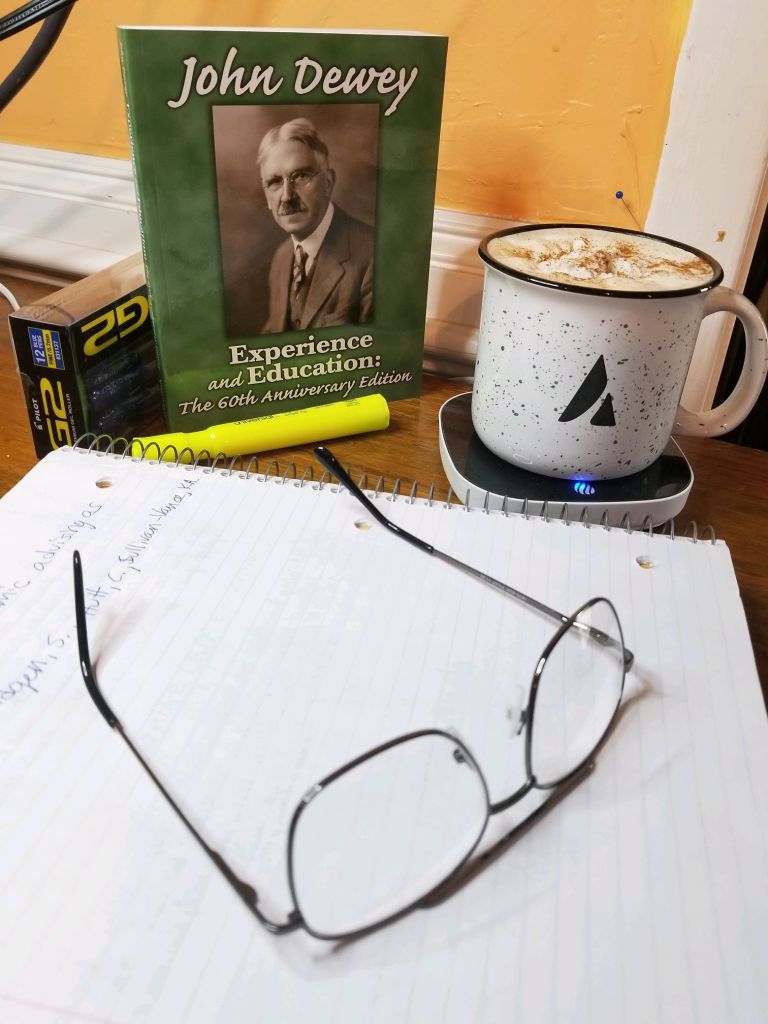
The strangest thing is beginning to happen. As I read literature, I recognize authors I have previously read, cited, and studied. This recognition of source material is a very entertaining phenomenon as I am reviewing and searching for new resources and information on my innovation topic.
Reading Action Research: Improving Schools and Empowering Educators by Craig Mertler has me reflecting upon the ADL program up to this point. We have poured blood, sweat, and tears into our innovation project. Now we are asked to research the validity of some aspect of our innovation or the innovation itself. I don’t know about everyone else, but I am freaking out at the possibility that I could determine my innovation is garbage!
I am wrapping my head around evaluative validity concerning qualitative research and am honest enough to acknowledge that remaining “unbiased” while reporting data is a tall order (Mertler, 2019, p. 142). I will keep reading in hopes that through this process, I will learn to be objective and see the greater good of refining my innovation, but in the middle of this book, I will honestly report that I am a little freaked out.
Reference
Mertler, C. A. (2019). Action research: Improving schools and empowering educators (6th ed.). SAGE Publications, Incorporated.
I needed a cup of coffee emoji for a walk-and-talk active learning session (because, of course!), and I stumbled upon this GOLD!!
Did you already know?!?!?! I was 100% unaware that emojipedia was a thing in existence and I feel like my life is somehow better now for it.
In one of our final course meetings, a classmate expressed some serious reservations about their final major assignment. Another fantastic community member messaged me, heartbroken about how we could help a classmate through their struggle. I created a zoom call and rallied the troops so that we could be supportive sounding boards to provide as much feed-forward as possible. This meeting took place after an hour-long class call and lasted another 40-45 minutes. I believe we all left the session with a better understanding of the assignment.
I wanted to share our discussion because I think it illuminates the purpose of our learning community component. As we discuss our ideas with others, we obtain clarity on our plans. As we support others in finding clarity for their ideas, we fortify our own.
 The Advisor That Cares