Action Research, ADL Program, Advising, Collective, Contributions, ePortfolios, Evolution, Goals, Growth, Growth Mindset, Innovation Plan, Leadership, Learner's Mindset, Learning, Learning Community, Personal, Professional, Reflecting

Contributions, 5315


Measurement Strategy Course

  • Spring 2023
  • Course Number: EDLD 5315
  • Course Title: Assessing Digital Learning and Instruction

Contributions to learning and learning community


I am giving myself a score of 97 out of 100

Crediting Core Group Members: Annababette DiemeckeAshleigh CarterKristin WinzerPatrick Rodriguez, and Valary Patterson

Crediting Collective Members: https://advising.blog/collaborations/

Key and Supporting

Contributions

Since I am not pursuing the accelerated path to program completion, I do my best to welcome new members to the learning community and help foster connections for others interested in similar projects. Many of us have stayed active in our collaborative group through a Google Drive and a GroupMe chat, both of which I host for the group.

Our learning community is committed to supporting one another. I have witnessed the power of the collective as members with no common classes come together to troubleshoot a website issue or clarify an assignment. Anytime, day or night, someone is willing to give support. I am excited to help foster that learning environment for myself and my classmates. I always ensure that I provide helpful feed-forward to my core collaboration group and all the members of the ADL Collective GroupMe chat.

I continue to refine, revisit and revise all prior assignments throughout this course, and this session pushed me to look objectively at my innovation plan. Learning about action research, struggling through writing challenges, and putting everything together into the final compilation continues to make this experience authentic. I can see my innovation coming to life. I am prepared to implement the strategies learned throughout.

I dissected the assigned course readings and pursued my information on the topics of this session. Specifically, throughout my literature review, I continued to deepen my learning on my topic as I followed links from cited sources.

I always met the course activity deadlines and posted discussion prompts and replies in hopes of engaging in a dialog about the action research process.

I engaged in every opportunity presented by hosting Zoom sessions and attending all class meetings and office hours. I engage in chat threads to review assignments, clarify questions, and provide support. I always cite source material in blogs and discussion postings. I have actively shared additional sources of information on the topics we study to offer breadcrumbs to my classmates and future ADL students and to further my understanding. I have truly embraced the learners’ mindset.

Reflections
What Worked?

In the simplest terms? The Learners’ Mindset

Embracing the opportunity to learn even more about my innovation plan worked. Completing my second literature review was an immense learning experience overcoming fears and self-doubt.

Sharing my writing struggles through blogging was also helpful throughout the learning process. As I worked through learning about action research, I blogged about the experience and my thoughts on narrowing my topic. I see the benefits of doing the work and evaluating the learning process.

The support given and found throughout the ADL Cohort Collective GroupMe chat is still the most humbling thing to witness. I created this group chat after losing all the members of my first learning community. Out of a desperate need to find myself a learning community, I founded a support group that I hope will continue long after I complete the program.

What could be better?

The semester had an unusual survival feel to it. I found myself craving the discussions and interactions my classmates and I have had over the last several semesters. I am trying to determine if the course material had everyone deep in the research process or if it was the time of the year keeping everyone busy with work and family commitments.

I kept giving support and encouragement by checking in with community members. The term seemed detached, collectively.

We still came together when a member needed help, but there were fewer in-depth conversations about our projects. Again, likely because of the nature of academic research and writing. I would have liked to experience more discussion on each course component. We had a few Zoom sessions and worked through assignments, but I missed learning with my classmates at the level we had in the past.

Action Research, ADL Program, Advising, ePortfolios, Evolution, Goals, Growth, Growth Mindset, Humor, Innovation Plan, Leadership, Learner's Mindset, Learning, Learning Manifesto, Personal, Professional, Professional Learning, Reflecting, Research, Why

Believe it

You have to believe it.

Leaning into the learners’ mindset, I have to ask myself daily to believe and trust it.

I have been entirely transparent about my writing struggles. I voiced in class that I need more confidence in my understanding of the subject matter to give my analysis and knowledge of other authors’ statements and research. This lack of confidence sends me back to the research reading and collecting more information, sources, and additional research. I can cite sources all day, but when I have to draw connections between material and express my understanding, I trigger memories of my K-12 educational experience and lose confidence. Research can become my distraction technique (an observation grad school has illuminated) to avoid the vulnerability that is academic writing.

Since I have reviewed hundreds of pieces of literature on my innovation topic formally over the last year and four months but professionally for the previous nine years and ten months, this topic is truly a passion project of the heart. Born out of desperation to help students, the advocate in me also desperately wants this tool for advisors. We are in tear-filled meetings over a crisis of self-issues. Advisors watch the battle young adults face with themselves over your disappointment if they decide whether or not they are pursuing their goals and dreams or yours.

I desperately want advising to be about the transformative development I read about in the literature. I felt disappointed after my first literature review as I recognized I was not meeting the goals and standards set by my profession. I now see that I am efficient at prescriptive advising. From a medical professional background, procedural information transfer, triaging issues, and answering questions came naturally. I know how to connect students to policy and procedures. I efficiently direct them to their departmental information on degree plans and course information. I am helpful and efficient at answering questions with source links (because advisors are only as good as the accuracy of the published information). I have always had an efficiency perspective. Therefore, I formalized my advising process, communications, and documentation for record keeping.

An advising course provides advisors and students a voice to illuminate problems faced by learners as expressed through cohort/meta-major discussions and assessments. Advisors could improve resources with an advising course, grade book, discussion boards, collaborative group sessions, and modules on common issues. Flipped advising would allow that effort to improve even further through media and collaboration with an advising team. I suspect turnover is both from burnout and demoralization. Advising is a passion profession. Many interview questions touch on helping people achieve their goals. Yet it can become a repetitive process of covering the same policies, procedures, and systems instead of all the things it could be if these items didn’t consume advising interactions. The ability to extend the advising sessions and depth beyond a 30-minute advising appointment twice a semester (optimistically). How can we help transform learners’ lives in 1 hour a term? Flipped advising would help us meet those needs while also relieving us of so many of the repetitive interactions we have day after day. Those fulfilling aspects of developmental advising forge a bond between advisor and advisee. Those connections are the ones that make commencement so special and a commitment to this profession so worth it.

Advisors consistently wonder if their efforts improved outcomes, but the cyclical and reactive nature of the industry can have us moving on to the next initiative with no feedback on the last one. Smiling faces that thank you for supporting them while wearing caps and gowns sure go a long way in motivating outcomes and innovations.

So now, I need to support all those beliefs with evidence from the existing literature.

By golly, I think I understand the point of a literature review finally.

Action Research, ADL Program, Advising, Goals, Growth, Growth Mindset, Leadership, Learner's Mindset, Learning, Personal, Professional, Reflecting, Research, Why

Research Fatigue


Top of a wooden pole is pictured with lines/wires coming from almost every direction in a tangled fashion.
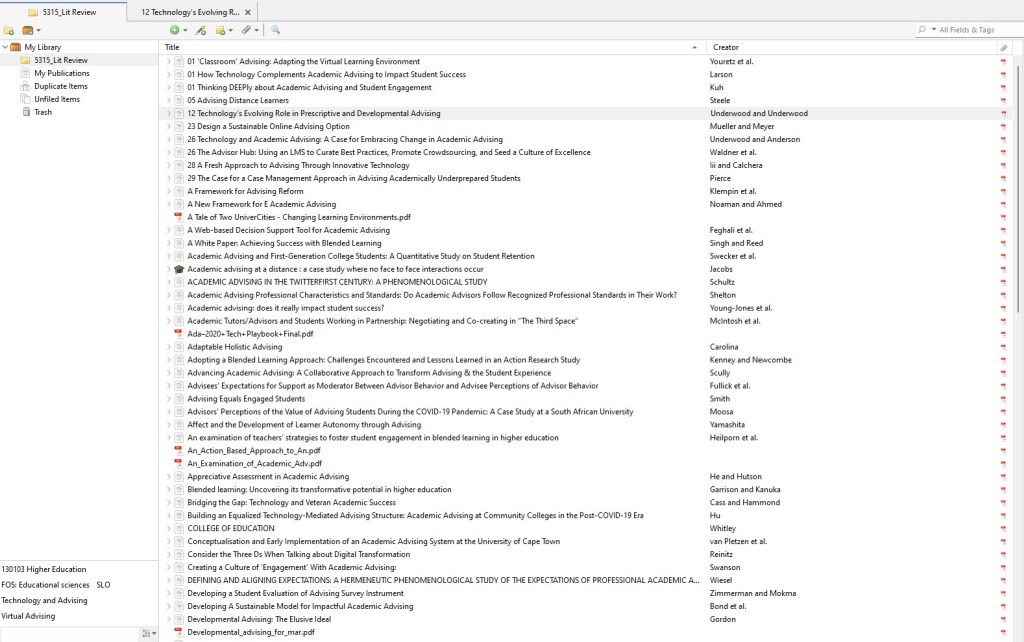
Screenshot of zotero organizing software for research sources.

I am stuck in this place where I keep seeking more and more research. I keep questioning my search terms and the relevance of the results. I thought I was sure about my research topic, but the more I read, the more lost I felt. Every article appeals to me because I do this as my career and for personal interest in graduate school. The topic of advising is a personal passion—making the connection between research and my belief that flipping advising can improve the prescriptive aspects (terminology picked up in the research process). As a result of flipped advising, additional time becomes available to dig into developmental aspects (more understanding learned through research) of the advising relationship.

I can tell that the advising relationship is important to me. My innovation is about creating a stronger advising relationship. My frustration with the prescriptive aspects of my role drives desperation to find an effective alternative solution. I am searching to find ways that creating space by limiting information transfer components will improve advising interaction through student empowerment. Relationships and empowerment are the answers to why I am doing this research. I am proposing this innovation, and why my initial step of action research has to focus on the first prescriptive step of course registration as the example of student agency. The administration is always going to focus on enrollment. Advisors want to help students get enrolled to begin fostering an advising relationship that can guide them through their educational pursuits and also help them explore their goals and aspirations.

I struggle to find specific sources for advising’s impact on student agency. Still, several sources reference student ownership and self-efficacy, making the connection clear enough to support the literature review and my research.

When I was initially researching what a literature review is, the Smart Student suggested that writer’s block indicates the need to do additional research, so then I go and read more literature. The cycle begins again!

I’m blogging through this process because I am determined not to let it break me (this time). I am determined to see through the purpose and meaning of this research process. I feel like I’m right on the cusp of understanding the point of this torturous exercise… errr I mean, I am embracing this authentic learning opportunity.

Action Research, ADL Program, Advising, ePortfolios, Evolution, Goals, Growth, Growth Mindset, Humor, Innovation Plan, Leadership, Learner's Mindset, Learning, Personal, Professional, Professional Learning, Reflecting, Research

Academic Writing & Mindset


I greatly appreciate Dr. Meeuwse holding office hours. This has rejuvenized the collaborative aspect of learning that I enjoy (and miss) so very much. I love that we have a facilitator who genuinely wants to help us be successful in our writing. I have picked up some great tips for approaching this literature review. I already feel more comfortable and familiar with the content of my research. I still really struggle to articulate how I believe my innovation plans are innovative and are the first of many steps toward a better experience for students and advisors.

Last week, Dr. Meeuwse shared a tip on her research approach during her doctoral experience.

She gave a beautiful nugget of knowledge when she suggested we approach paraphrasing by making bullet points of no more than two words (citing the source as we go) while reviewing relevant literature.

Tonight she gave additional details.

Read the article through, read it aloud, making bullet points with in-text citations, then put it away (the source material). Go and write sentences from memory (trying not to return to the source material so you aren’t tempted to reuse the authors’ words or meanings instead of expressing your learning).

This program’s craftsmanship never ceases to amaze me. I have a very specific visual image in my head of Dr. Harapnuik telling us how sneakily he manipulates us into learning.

Embarking on this course, I really had to give myself a pep talk. I dreaded whichever class had another one of those dang lit reviews. I forced myself to reflect as those old patterns of panic tried to creep in. Almost immediately, I recognized that I had to own whether or not I had embraced and accepted a learner’s mindset. Would I let research and academic writing scare me away from the authentic work I have been doing throughout this program to bring flipped advising to life?

Looking at the work I have completed up to this point in the program made me recognize that I am very familiar with my innovation plan. I am approaching my research efforts with much more specificity than my first attempt at a literature review. I definitely have a better understanding of the point of the darn thing. I am still struggling to explain what I hope to do with flipped advising and how students accurately identifying coursework for registration is the first significant step forward for our advisors and students.

Nonetheless, by standing on multiple means of support found in the literature, I will have a clearer picture of exactly how action research will guide the process toward revolutionizing advising.

Action Research, ADL Program, Advising, ePortfolios, Goals, Growth, Leadership, Learner's Mindset, Learning, Personal, Professional, Professional Learning, Reflecting, Research

Professional Learning Plans


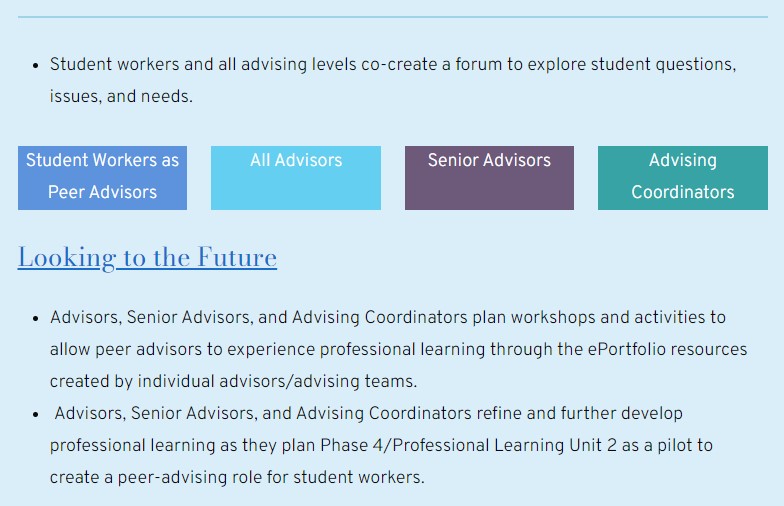
In my quest for research for my action research literature review, I came across an article that immediately made me think of my professional learning plans. Specifically when looking to the future of professional learning and how an innovation to advising could transform advising interactions.

Screenshot of "Looking to the Future" section of linked webpage.

Academic Tutors/Advisors and Students Working in Partnership: Negotiating and Co-creating in “The Third Space”

I did not even realize it, but this is an exciting “perspective piece” to find as a wonderful confirmation of what I envisioned throughout my professional learning plans that include this type of peer partnership.

Reference

McIntosh, E. A., Steele, G. E., & Grey, D. (2020). Academic tutors/advisors and students working in partnership: Negotiating and co-creating in “The third space.” Frontiers in Education, 5. https://doi.org/10.3389/feduc.2020.528683

Action Research, ADL Program, Advising, ePortfolios, Goals, Growth, Growth Mindset, Influencer, Innovation Plan, Leadership, Learner's Mindset, Learning, Personal, Professional, Professional Learning, Reflecting, Research

Relevant Research


So I really feel like I have been on a quest for precisely the type of information I just found.

Transformations in academic advising as a profession

For the first time, I have found a recent piece of literature that connects directly to the goals of my innovation plan. Let me see if I can explain this connection and my excitement at finding it.  

I struggle to accurately explain why an innovation involving blended learning (Horn & Staker, 2017) could revolutionize advising. An advising innovation will impact students and advisors at my institution for all reasons cited in this body of work.

My innovation plan seeks to create more time and comfortable space within advising appointments for meaningful interactions (Troxel et al., 2021). Until we find an effective way to get the course registration and degree plan requirements out of the way, advising will continually miss potentially life-altering opportunities. 


My action research study will utilize a quantitative design to narrowly focus on any correlation between study agency over accurate course registration and a blended learning advising module on the same topic. 

  • Variable one:
    • blended learning advising module covering how and where to find degree plan requirements, degree progression plans, course registration procedures, and other registration-related tasks such as holds, balances, or action items needed for course registrations. 
  • Variable two: 
    • Student agency, as evidenced by the ability to outline course plans accurately and effectively before the advising session for the upcoming registration period. 

Methods:

  • Student pre-advising Likert and Likert-like questions regarding upcoming course registration, advising module information, and overall perceptions of readiness for next semester’s course registration
  • Advisor post-advising Likert and Likert-like questions regarding the accuracy of course selections made by the student, the quality of questions students ask during advising sessions and the advisor’s perceptions of the student’s preparedness for course registration. Advisors will rank the accuracy of registration plans and relevance to the student’s degree program. Finally, advisors will rate the overall advising interaction and depth of conversation. 

References

Horn, M. B., & Staker, H. (2017). Blended: Using disruptive innovation to improve schools. John Wiley & Sons.

Troxel, W. M., Bridgen, S., Hutt, C., & Sullivan‐Vance, K. A. (2021). Transformations in academic advising as a profession. New Directions for Higher Education, 2021(195–196), 23–33. https://doi.org/10.1002/he.20406

Goals, Influencer, Leadership, Personal, Professional, Professional Learning, Reflecting, Why

Redefining Leadership


“Are you a leader” (TEDx Talks, 2010)?

Are you an important person in someone’s life? Maybe you need a new definition of leadership. In the following TED, Drew Dudley illustrates how powerful you might be in another person’s life without knowing it.

“Every time you change one person’s understanding of the world. One person’s understanding of how many people care about them. One person’s understanding of what they are capable of. One person’s understanding of how powerful an agent for change they can be in this world. And more importantly how powerful an agent for change they can be in their own life. Every time you change one person’s understanding of the world, you change the whole world” (Speakers Spotlight, 2019).

Leadership is about “how many [lollipop moments] you empower other people to create for themselves” (Speakers Spotlight, 2019). I plan to carry this definition of leadership with me as I create professional learning opportunities and move forward with my innovation plans.

I want to help create lollipop moments.

References

Speakers Spotlight. (2019, July 19). Recognizing the Power of Lollypop Moments | Drew Dudley [Video]. YouTube. https://www.youtube.com/watch?v=lU06fAhLKvU

TEDx Talks. (2010, October 7). TEDxToronto –  Drew Dudley “Leading with Lollipops” [Video]. YouTube. https://www.youtube.com/watch?v=hVCBrkrFrBE

ADL Program, Advising, Evolution, Goals, Growth, Growth Mindset, Influencer, Leadership, Learner's Mindset, Learning, Learning Community, Personal, Professional, Professional Learning, Reflecting

Change hurts


My department is going through so many simultaneous changes right now. It is difficult for many to adapt and adjust. Still, I am doing what I can to share my heart, highlight the opportunities, and allow everyone to propose solutions.

I have witnessed firsthand the panic caused by sit-and-get training. Over the last several weeks, individual teams have come together to receive an overview of each other’s degree plans and departments and to build a collaborative network of support by grouping majors into career clusters and communities of interest, also known as meta-majors. This change poses a complete shift in everything our advising unit has ever done. It requires that advisors expand beyond specializing in one to a few majors to an entire catalog of majors based on four broad categories (arts, communication, and education; business and industry; public service; or science, technology, engineering, and math).

Add to this challenge that our office desperately needs more staffing due to several departmental challenges, including a complete restructuring and new leadership.


Change heals


The restructuring has provided leadership opportunities at every level. Some have arisen to the challenge, and I can hear hopefulness in their voices again. Some are still overwhelmed and doing their best to hold on for the learning ahead of us. Our advising unit has a long history of high turnover. Party because only a few people understand what goes into academic advising and the high demands of the profession. Others are looking to begin a career at an institution of higher learning, and advising is a common entry point for those with a degree. Many in our advising unit are working outside of their degree areas. Several advisors are either working toward, hold a graduate degree, or have multiple degrees because they understand the value of an education. They flourish as the leaders and teams embrace the opportunity to build solutions to advising challenges.

As I watch the team members working together, I see healing happening. I see a positive workplace culture forming. I see such great brainstorming and communication happening all across the advising unit. I see individuals that no longer feel like separate islands doing their own thing. Instead, I see warriors dressing for battle, determined to make it through the challenges and frustrations that change brings to make things even better than they were before.


Change


As advisors find hope in a supportive environment, I see a team that will embrace change in the future as an opportunity.

“There is nothing permanent except change”

— Heraclitus
ADL Program, Advising, ePortfolios, Growth, Growth Mindset, Growth Mindset Plan, Influencer, Innovation Plan, Leadership, Learner's Mindset, Learning, Personal, Professional, Professional Learning, Reflecting, Why

Advisors as Learners


I am well into my graduate program, and I see with clarity how well-designed this program has been crafted. We are living-learning opportunities that we can apply to our specific situation (Principle 5, by the way). Throughout every step of the program, I have reflected that I feel torn between two audience options (students and colleagues).

My innovation was selfishly born out of my desperate need to meet the needs of my learners (students/advisees). Feeling worn out, abused, disrespected, and undervalued as a knowledgeable resource to many frustrated students and as a professional – I desperately wanted to increase student motivation to seek information for themselves. Acknowledging the often complicated and multi-sourced ways to process information and situations, my ePortofolio sought to provide an easy-to-locate resource that consolidated all those sources by topic and included personal tips and advice that I would give during an advising appointment on the subject. I found myself so inspired (and challenged) by the UbD Template. Building understanding and intrinsic motivation into my advisees/learners through the design of every interaction opportunity. Creating a resource that is available when common questions arise to create a ubiquitous resource available anytime (i.e., peak advising season when I could have slower response times or in the middle of the night on a drop deadline).

As much as I advocate for students, I also have an advocate’s heart for my fellow advisors. I cannot even begin to describe the amount of information advisors relay. The unfortunate reality is that sometimes these professionals are underprepared and uninformed, thereby affecting students in their learning journey. I want advisors to be knowledgeable, and I want them to have connections across the institution so that we can guide students in their academic journey. As I begin to plan how to utilize going training and continual support to truly innovate advising through this first of many professional learning opportunities.

I have tried to describe my innovation to others and wondered if it is innovative. However, as I approach this professional learning task, I am seeing exactly what I had in mind for my innovation idea. As advisors experience choice, ownership, and voice through an authentic learning environment, they will have a greater opportunity to provide that for their learners/advisees. I see now that my learners are a team of advisors who have a wonderful opportunity to impact the lives of their learners. They can change the world one learner at a time.

ADL Program, Advising, ePortfolios, Goals, Influencer, Innovation Plan, Leadership, Learner's Mindset, Learning, Personal, Professional, Professional Learning, Reflecting, Why

A Call to Passion


“A call to passion” is exactly what Developing Effective Professional Learning means to me. I am so excited to share professional learning with each of you! We have the overwhelming honor of helping others utilize their passions through the adventure of learning. Together.


As a student, beginning a new chapter of life can be overwhelming. You are an adult, which you have been looking forward to for as long as you can remember. But you are also stepping outside of your comfort zone. Really finding yourself. Discovering who you want to be without the primary inputs that previously surrounded you.

As advisors, we are honored to help guide students as they begin University life. My research shows that the advising relationship is significant to students’ perseverance through what can be a challenging adjustment. Nevertheless, how many times has this significance escaped you? How often have you felt like a broken record? How exhausting can it be for you and the student as you frantically attempt to cover so many things? Just a few examples come to mind like the university’s policies and procedures; system access and onboarding; information about the program, department, and academic college; outlining course options, prerequisite sequences, and electives selections; confirming career goals for major alignment, not to mention informing students of the multiple support resources and offices across campus. How often do we find ourselves desperately trying to get to know our students on the walk to our office or in the brief moments before or after the information download I just described? When are we supposed to find that moment to connect with them so that we can help them make meaning of their learning, struggles, and opportunities to grow?


We can embrace professional learning by moving away from the current professional development model. We can find personal relevance and engage passions as our mission resonates. Doing so requires that our support be ongoing. We want to give good training, but don’t want to stop there. We want to build teams with peer coaching that happens throughout implementation. We can encourage active engagement, and we can model our new skills. As we do these things, we will see an increase in adaptability to our specific situations and even more adoption of our innovation. We need frequent communication to know what is working and what needs improvement.

View in Canva

As we embrace this new professional learning model, we will find success in addressing challenges, improving delivery methods, and creating time and space for advisors to do what they do best, connect with students.