ADL Program, Advising, ePortfolios, Evolution, Goals, Growth, Innovation Plan, Leadership, Learner's Mindset, Learning, Learning Community, Personal, Professional, Professional Learning, Reflecting, Tips

What Is vs. What Could Be


As a student, it can be very overwhelming to begin a new chapter of life. You are an adult, which you have been looking forward to for as long as you can remember. But you are also stepping outside of your comfort zone. Really finding yourself. Discovering who you want to be without the primary inputs that previously surrounded you.


As advisors, we are honored to help guide students as they begin University life. My research has shown that the advising relationship is significant to students’ perseverance through what can be a challenging adjustment. Nevertheless, how many times has this significance escaped you? How often have you felt like a broken record? How exhausting can it be for you and the student as you frantically attempt to cover so many things? Just a few examples come to mind like the university’s policies and procedures; system access and onboarding; information about the program, department, and academic college; outlining course options, prerequisite sequences, and electives selections; confirming career goals for major alignment, not to mention informing students of the multiple support resources and offices across campus. How often do we find ourselves desperately trying to get to know our students on the walk to our office or in the brief moments before or after the information download I just described? When are we supposed to find that moment to connect with them so that we can help them make meaning of their learning, struggles, and opportunities to grow.

Through an Innovation to Advising, we can provide relationships that provide reassurance and guidance throughout each student’s academic journey.

Join me, and together we can make a difference.

ADL Program, Collective, Contributions, Evolution, Goals, Growth, Influencer, Leadership, Learner's Mindset, Learning, Learning Community, Personal, Reflecting

Contributions, 5304


Organizational Change Course

  • Fall 2022
  • Course Number: EDLD 5304
  • Course Title: Leading Organizational Change Course

Green sign with white arrow point upwards with the words "Change Ahead" centered underneath.

Contributions to learning and learning community.

I am giving myself a score of 95 out of 100

Crediting Core Group Members: Adrianne Ortiz, Annababette Diemecke, Ashleigh Carter, Kristin Winzer, Patrick Rodriguez, and Valary Patterson

Crediting Collective Members: https://advising.blog/collaborations/


Key Contribution

I met all activity deadlines and requirements throughout the semester by their posted deadline. Each semester I work to review and revise my previous work. As I gain a greater understanding of the task (this learning approach), I can evaluate and determine if my past work is meeting those outcomes and objectives. This semester (and more specifically, this course) enabled me to expand those past assignments beyond my wildest dreams. I am more equipped to carry my innovation plan forward through the Crucial Conversations content. I will be able to thoroughly assess my motives for myself and those with whom I need to engage in productive dialog. The gained confidence through thoughtfully planning the Influencer Strategy and the 4 Disciplines of Execution will help me be a self-differentiated leader that will provide the calm resolve to stay the course, despite the year-round advising whirlwind.

What worked

In addition to completing all course readings, videos, and supporting research, I thoroughly explored and welcomed every technique and piece of advice offered by the content presented. The subject matter could not be more desperately appropriate to my situation. While the reading load was heavy, the content was so interesting I found it easy to review it multiple times in multiple formats. I discovered last semester that incorporating audible along with the book while outlining and note taking while taking various times through the content helps me uncover the depth of the content. That proved especially true this semester as the authors were presenting essential “how to” guides for influencing behavior change, executing the plans, and holding difficult and uncomfortable conversations in the midst of it all. I continue to embrace the learner’s mindset and am grateful for the authentic learning opportunity my innovation project has become.

What could be better

I am still guarded about some of the work I am doing in the program. Maintaining my professional voice while balancing act between vulnerability and authority is a reoccurring struggle. The content on self-differentiated leadership initially felt cold and distant, but I realize there is a strength that comes with the confidence of effective dialog to create solid plans.


Supporting Contributions

What could be better

Unfortunately, the discussion boards and posts still feel too checklist/regurgitation model. Everything else about the program is so very authentic, but something still lacks from the formal “class discussions.” Other people may feel like they are having valuable in-depth conversations about the content of the different modules but have been lacking in this area throughout most of the program. Additionally, there is so much benefit from regular virtual synchronous meetings. Our collective does a great job of filling in the space daily so that the entire cohort has become a learning community. I don’t know if others have small groups they meet with regularly, but most of us rely upon the collective we have formed. I have always left our collaborations feeling like I have a better understanding of the content, an assignment, or just better in general for helping to provide clarity to someone else.

What worked

The ADL Cohort Collective group chat is the most supportive and beneficial part of the program for me. Each semester we add members to the group, and people are at all different levels, but we have found support through one another. I continued my responsibilities within the group and generally tried to maintain a welcoming and supportive environment for others to participate.

Early in the semester, I created a course calendar using the template of Dr. Grogan’s EDLD 5313 calendar. The calendar helped me keep up with assigned readings, assignment due dates, and other important deadlines. I shared this via google docs for the collective.

I continue to enjoy the role of facilitator. I am excited to embrace this personal strength and passion as I move into holding crucial conversations with my team in my new leadership role.

Advising, Collective, Evolution, Goals, Growth, Innovation Plan, Learning, Learning Community, Personal, Professional, Reflecting

C. C. C.


Collaboration Coalition Collective

Collaboration: “noun the action of working with someone to produce or create something”

https://languages.oup.com/google-dictionary-en

Coalition: “noun an alliance for combined action, especially a temporary alliance of political parties forming a government or of states”

https://languages.oup.com/google-dictionary-en

Collective: “adjective done by people acting as a group”

https://languages.oup.com/google-dictionary-en
ADL Program, Collective, Evolution, Goals, Growth, Growth Mindset, Learner's Mindset, Learning, Learning Community, Personal, Professional, Reflecting

Educational Trauma


This morning in my daily scroll, I saw the following come up in a random group I follow. I couldn’t help but extrapolate this to our learning experience and the difficulty we all confront as we form Learning Communities and try to form trusted relationships for feed-forward. I suppose not everyone struggles with these aspects of trust, but I certainly do. Therefore, I wanted to share this here in hopes that it helps you as you form connections and build trust.

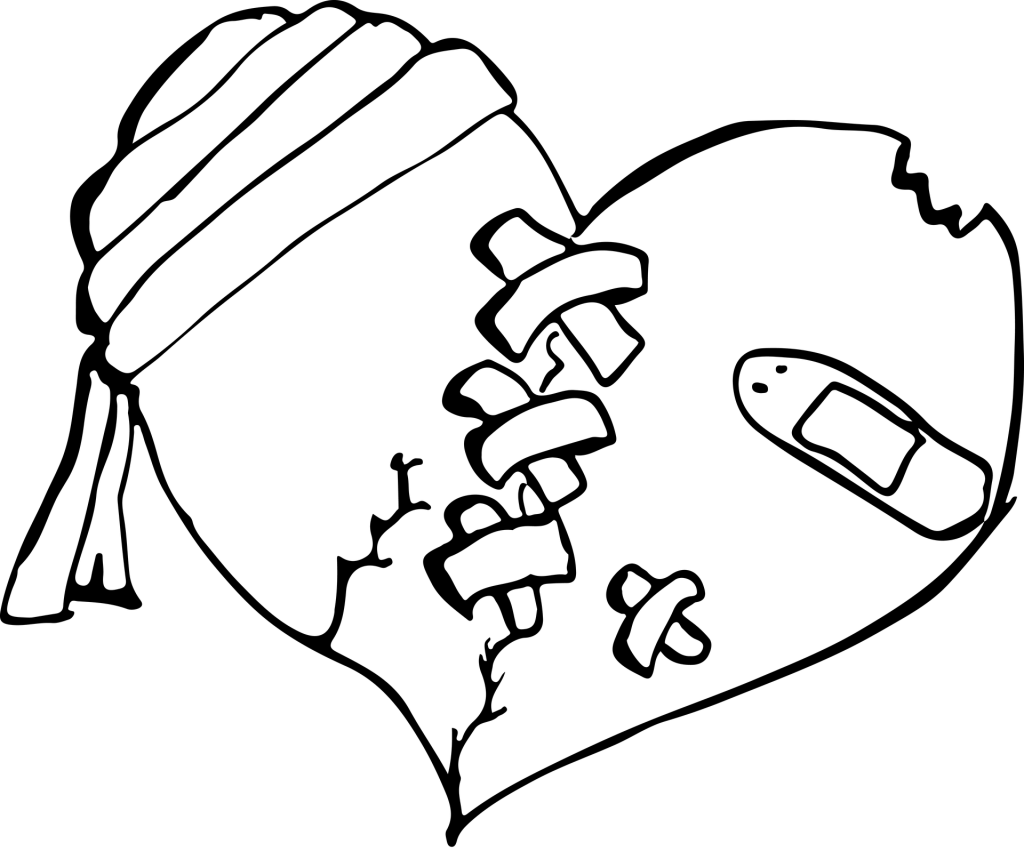
The image of a cartoon heart is band-aided and stitched with cracks and a small piece is missing.

“The inability to receive support from others is a trauma response.

Your “I don’t need anyone, I’ll just do it all myself” conditioning is a survival tactic.

And you needed it to shield your heart from abuse, neglect, betrayal, and disappointment from those who could not or would not be there for you.

From the parent who was absent and abandoned you by choice or the parent who was never home from working three jobs to feed and house you.

From the lovers who offered sexual intimacy but never offered a safe haven that honored your heart.

From the friendships and family who ALWAYS took more than they ever gave.

From all the situations when someone told you “we’re in this together” or “I got you” then abandoned you, leaving you to pick up the pieces when shit got real, leaving you to handle your part and their part, too.
From all the lies and all the betrayals.

You learned along the way that you just couldn’t really trust people. Or that you could trust people, but only up to a certain point.

Extreme-independence IS. A. TRUST. ISSUE.

You learnt: if I don’t put myself in a situation where I rely on someone, I won’t have to be disappointed when they don’t show up for me, or when they drop the ball… because they will ALWAYS drop the ball EVENTUALLY right?

You validated your core belief that you can’t really trust people! That is how much you believe it! Your wiring is hooked up to this belief system.

You may even have been intentionally taught this protection strategy by generations of hurt ancestors who came before you.

Extreme-independence is a preemptive strike against heartbreak.
So, you don’t trust anyone.

And you don’t trust yourself, either, to choose people.

AND you don’t trust life itself maybe? Does Life have your back?

To trust is to hope, to trust is to be vulnerable.

“Never again,” you vow. Consciously or subconsciously.

But no matter how you dress it up and display it proudly to make it seem like this level of independence is what you always wanted to be, in truth it’s your wounded, scarred, broken heart behind a protective brick wall.

Impenetrable. Nothing gets in. No hurt gets in. But no love gets in either.
Fortresses and armor are for those in battle, or who believe the battle is coming.

It’s a trauma response.

It is an old wounding layer in your system that needs new wiring, a do over.

The good news is trauma that is acknowledged is trauma that can be healed.

You are worthy of having support.

You are worthy of having true partnership.

You are worthy of love.

You are worthy of having your heart held.

You are worthy to be adored.

You are worthy to be cherished.

You are worthy to have someone say, “You rest. I got this.”

And actually deliver on that promise.

You are worthy to receive.

You are worthy to receive.

You are worthy.

You don’t have to earn it.

You don’t have to prove it.

You don’t have to bargain for it.

You don’t have to beg for it.

You are worthy.

Worthy.

Simply because you exist.”

The words "You are enough" are written above the image of two teal and brown chairs and a table that has a matching flower vase atop filled with purple folowers.
ADL Program, Learning, Learning Community, Tips

Searching


Image of a magnifying glass within a circle illustration

There’s a little trick/tip I picked up somewhere for how you can search for just about anything. I’ll use an example from our class call last night.

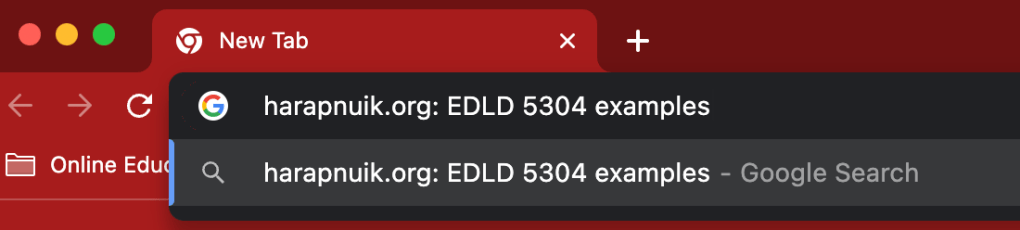
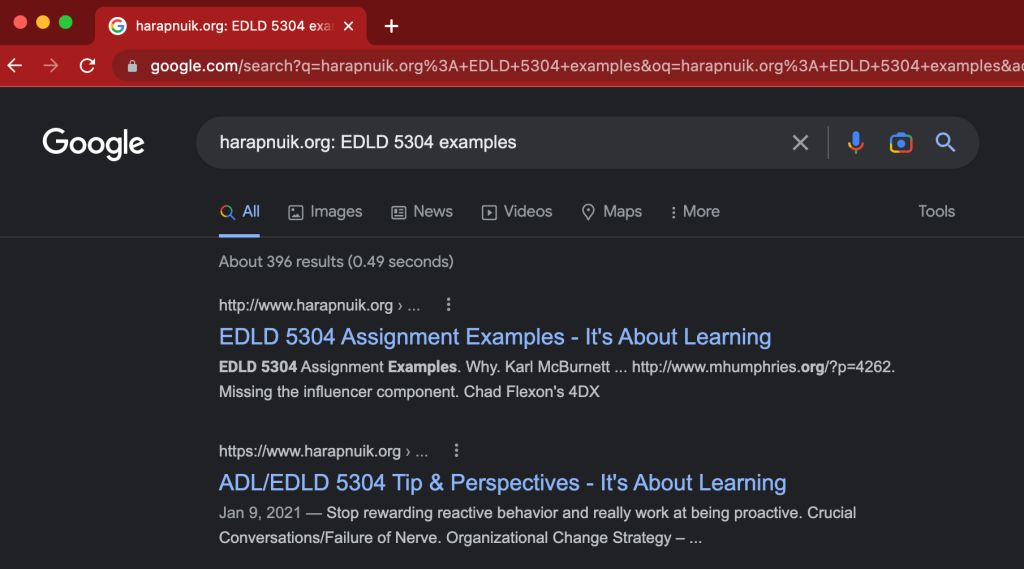
The program map came up in conversation when someone asked about examples for the Organizational Change course. I quickly opened a browser window and typed “Harapnuik.org: Program map,” which immediately led me to the ADL Program Map.

Do you know of a website where you once saw something type that site into your search bar, then type a colon followed by a term for what you want to search for on that site? Give it a try! This little trick has served me so well that I wanted to share it with all of you.

Screenshot of google search bar searching for "harapnuik.org: EDLD 5304 examples"

Screenshot of google search results showing EDLD 5304 Assignment Examples and ADL/EDLD 5304 Tips & Perspectives both from It's About Learning at www.harapnuik.org
ADL Program, Collective, Contributions, Evolution, Growth, Growth Mindset, Learner's Mindset, Learning, Learning Community, Personal, Reflecting

Contributions, 5313


Creating Significant Learning Environments (CSLE) Course

  • Fall 2022
  • Course Number: EDLD 5313
  • Course Title: Creating Significant Learning Environments

Square orange sign tilted so that one point of the square points upward, centered are the words "Detour Ahead"

Contributions to learning and learning community.

I am giving myself a score of 96 out of 100


Crediting Core Group Members: Kristin Winzer, Patrick Rodriguez

Crediting Collective Members: https://advising.blog/collaborations/


Key Contribution

I met all activity deadlines and requirements throughout the semester by their posted deadline. Each semester I work to review and revise my previous work. As I gain a greater understanding of the task (this learning approach), I can evaluate and determine if my past work is meeting those outcomes and objectives. This course has provided a greater understanding of the importance of the learning environment I am creating. Everything we do should focus on learning, and how we approach subjects can tap into a learner’s thirst for learning or squelch it. I want to help reignite that natural love of learning so that my learners can be both successful and lifelong learners. 

What worked

In addition to completing all course readings, videos, and supporting research, I embraced research this semester. I found that the best way to understand the different topics was to give myself as much context and related information as possible. In doing so, I watched/read the provided content, followed all the associated links, researched for related information, watched relevant media, and took many notes. This means of forming context allowed me to better synthesize my understanding of everything. I faced several projects that were entirely new for me. These new concepts and tasks made me work extra hard to teach myself as much as possible. This course was my first of really long study nights and limited sleep. If there is one thing that this program has taught me: I have the power to learn and improve when I feel weak or unfamiliar with something. For example, I believe my academic writing skills could use improvement. Therefore, in addition to my typical YouTube search to learn about “how to write an argumentative paper?,” “How to write a response,” and “What is an annotation?” I attended an online writing workshop to try and help with my ability to paraphrase and improve my overall writing skills.

I am trying to keep up with blogging and tracking some of my thought processes (thinking about my thinking). I am trying to embrace and trust the ADL program (COVA+CSLE). I recognize that reflection is a crucial aspect of learning. I have also hoped that I could further help facilitate learning how to learn by documenting the stages and steps in my learning process. Additionally, those proved very helpful in the compilation because those blogs helped me reflect upon the process and my facets of understanding to see myself in each piece of that learning opportunity. 

What could be better

I still struggle quite a bit with the best way to keep up with academic research. I have a variety of folders and drives just full of PDF documents. I have been saving my research related to different assignments or projects. Still, I think having a better system to organize my research would allow me to draw from multiple overlapping resources as relevant and needed. I tried a couple of online research systems. Still, they all seemed very time intensive, with multiple entries required for each resource. I am considering starting a gigantic, annotated bibliography since that was something we have done in a couple of classes thus far. I can see how the summary of why the source is relevant to me could be beneficial. 

I am also finding that I lack the confidence I think I need to synthesize information effectively into my own words. I struggle with not just creating a quote-fest and submitting it as an assignment because the source material is all so new to me. I feel that I’m still really finding it a challenge to process and paraphrase (with citations) instead of just direct quoting. 

I recognize this semester that I need to work harder to keep the forward progression in the modules. Instead of focusing on a given week’s readings/discussions/projects, the future modules don’t get addressed until the previous one is complete. I recognized that this provides additional context and increases the synthesis of information instead of trying to keep everything so compartmentalized between projects/modules. I can get too focused on the immediate that I can forget to consider/plan for the long term.

I’m unsure if I should actively seek comments on my blogs/EP. I know from our ePortfolio class that likes, reshares, and comments are what drives the audience. Should I ask my classmates to visit my blog and leave comments, or am I just hoping to connect with readers with common interests? I feel like this is an area where I could improve my understanding and ensure that my ePortfolio functions as a learning space, a personal narrative, and a place to help others in their learning journeys. 


Supporting Contributions

I think I will address my supporting contributions in reverse order since I am already reflecting on what could have been better. Plus, then I get to wrap everything up on a positive note. 

What could be better

I feel terrible admitting this, but I have committed to transparency in my learning journey. I genuinely believe I can learn from this first reflection what I could have done better. I completely dropped the ball on my learning community this semester. I spoke with my group last semester, and we were all set to collaborate again this session. We continued with our chat and google drive. Our last class was the Concepts of Educational Tech course, and I created shared documents for our group discussions. Still, no one interacted with them, as we had in our Applying Digital Tech /ePortfolio course. Last semester, there didn’t seem to be as much focus on the blog posts and group discussions as there was in the ePortfolio course. I thought I would try this session again, so I created a few module reminders/guides/checklists and started group discussion threads.

The first one or two discussions passed without interaction, and I assumed the group was meeting and collaborating in another fashion. Since everyone else was a K-12 teacher with similar innovation plans, they took two classes instead of one. In past semesters, they explained that they often met about the class I wasn’t in and covered questions/material for both courses. I am embarrassed to admit that I just assumed the worst and leaned into the ADL 2021-2023 group chat to share my assignments, seek collaboration/support, and feed-forward. During my breakdown crisis of self over the UbD template assignment, one of my previous groupmates said, “I know you haven’t been sharing your assignments as we have, but ours are there if you think more examples will help you.” I didn’t even realize they were uploading assignments to our shared drive. After a couple of weeks of no interaction in the early part of the semester, I stopped checking. I felt like such a jerk; I had no idea. My groupmate was utterly kind and supportive, which was so amazing in my moment of dismay. I am fortunate to be in this program with wonderful people who extend grace and understanding. I learned a valuable lesson on the importance of communication and transparency. I should have just asked, are we still collaborating? Is there another group chat somewhere? Am I missing something? 

What could be better? I recognize that I need to speak up instead of just retreating into my feelings and making assumptions. 

However, I did find a few different things that worked this semester. 

What worked

I continued leadership responsibilities within the online ADL 2021-2023 group chat, which helped me connect with the ADL cohort. I wanted to stay connected with my cohort as I have seen previous cohorts remain connected and supportive throughout every program stage. Additionally, selfishly my learning cohort will change every two semesters or so. So I needed to find a way to foster new relationships, develop opportunities to mentor and for mentorship, and maintain connections with the incredible network I am making. I also wanted to provide that level of community connection for others who might be returning to the program. I recognize that in groups, there can be any number of personalities, schedules, and other dynamics of the human dimension. It is important to me that there is a place open to everyone so that no one goes without that collective component that seems so integral and valuable to the learning process. I appreciate that we have students from all levels in the chat, allowing students further along in the program to give guidance and context for questions that arise.

The group has become an incredible collective and support system for many of us. At almost any hour (day or night), we can reach out and get feed-forward, ideas, and input from one another. Additionally, we can provide the same for those progressing further behind us. It has been nice to see our cohort share professional challenges and opportunities. 

I enjoy the role of learning facilitator and resource. Throughout the semester, I would post reminders to the group chat about discussion posts, due dates, comment deadlines, and upcoming assignments. I would individually reach out to people who had not yet posted or commented by those deadlines for the first week or two. I enjoy being that helpful friend who understands how busy life can make us. I believe this allowed most of us to successfully keep up with the timely postings and active contributions for myself and the group. Seeing the group take ownership of that chat and step up to support and mentor one another has been gratifying. I think that ongoing collaboration helps in the bond our cohort shares. 

Through our class meetings and the group chats, I identified Kristin, another non-classroom educator. I reached out her via course mail a few times and expressed a sincere interest in working together. We bonded and built a learning community over our connection and struggles of translating what we teach and our learning environments from application in K-12 education settings. Kristin said that she was collaborating with Patrick and that it would be great for us to all see how we could support one another. I was in a group chat with Patrick, started by Jasmin, so I was excited to share my assignments and struggles with each of them. I finally tried to do a better job of not just providing support but also asking for support. I recognized this as something that could be better in my last contributions to learning reflection, so I pushed myself to share more vulnerability in this area. The payoff was so rewarding. I watched my learning community members grow and expand their portfolios and confidence with each passing conversation and assignment. 

I feel a special place in my heart for this course and this learning experience. I felt the connection in this course, maybe because of the vulnerability and openness we shared, or perhaps it was just all the communication and collaboration. I also tried to stay tuned to the student/faculty discussion thread and keep conversations active in class meetings, chats, and course mail. I am excited to continue learning, applying, and revising my work and understanding as we progress through the program. 

I guess the advice I want to leave here for myself and others is to Embrace the process, accept the change, and in the wise words of our fearless facilitator, “Say yes!” (Grogan, 2022).

ADL Program, Collective, Evolution, Goals, Growth, Growth Mindset, Growth Mindset Plan, Learner's Mindset, Learning, Learning Community, Learning Manifesto, Personal, Professional, Reflecting

Revisiting Reflections


This week, we are revisiting some of our previous Growth Mindset content and reflections. As I re-watch the Learners Mindset Discussions, Episode 20, I am almost overcome with confirmation of so many things going through my mind these days.

When I was struggling with the thought of enrolling in the ADL Program, I watched so many LMD and ADL content, just trying to get a sense of the program. Dr. Thibodeaux‘s vulnerability spoke directly to my fixed mindset, to my wall of fear, to my heart. This discussion topic was the subject that sealed the deal for me.

Now I review the discussion and have a whole new perspective on the conversation. I understand what the instructors mean when they say that the environment we can create for our learners is the key to transformation, transference, and triumph (I wanted to say success but couldn’t resist the 3T’s). I understand it because they provided that very environment to learn for me.

We now get to create the environment through our essential questions/understandings. It is overwhelming. It is exceptionally challenging. But aren’t we “smashing through the walls of fear?” Aren’t we “setting our course by the light of the stars?” Aren’t we here “to change the world?” That is big and overwhelming, but our instructors believe in us. We believe in each other. And just because I know I need to hear it and you might too, I believe in you!

CSLE2COVA. (2019, April 5). LMD EP20 Growing A Growth Mindset. YouTube. https://www.youtube.com/watch?v=yR7uCZGPZ5k

References

CSLE2COVA. (2019, April 5). LMD EP20 Growing A Growth Mindset. YouTube. https://www.youtube.com/watch?v=yR7uCZGPZ5k

ADL Program, Collective, Contributions, Evolution, Growth, Growth Mindset, Humor, Learner's Mindset, Learning, Learning Community, Personal, Reflecting, Tips

UbD Collaboration


In one of our final course meetings, a classmate expressed some serious reservations about their final major assignment. Another fantastic community member messaged me, heartbroken about how we could help a classmate through their struggle. I created a zoom call and rallied the troops so that we could be supportive sounding boards to provide as much feed-forward as possible. This meeting took place after an hour-long class call and lasted another 40-45 minutes. I believe we all left the session with a better understanding of the assignment.

I wanted to share our discussion because I think it illuminates the purpose of our learning community component. As we discuss our ideas with others, we obtain clarity on our plans. As we support others in finding clarity for their ideas, we fortify our own.

Course Info

  • Course Number: EDLD 5313
  • Course Title: Creating Significant Learning Environments
  • Instructor: Dr. Kelly Grogan
  • LU’s Applied Digital Learning Program
  • Fall 2022, first eight-week session
  • UbD Template – Assignment
Advising, Collective, Evolution, Learner's Mindset, Learning, Learning Community, Personal, Professional, Reflecting, Tips

Cultivating Dreams


This afternoon I had the pleasure of attending the following Coffee Chat with my professional organization. I found the resources shared so valuable and timely that I wanted to post some of the links and ideas to reflect upon as I address learning outcomes in my upcoming assignment.

Excellent small group discussions with advising colleagues and brainstorming session on dream inducing questions like:

  • What did you always want to do/be when you grew up? And why?
  • What does good academic standing look like to you this semester, and how does that bring you one step closer to your dream/ideal profession?
  • What inspired you to come to this institution, and how does that “why” drive you closer to your dream?
  • What are things that you loved to do when you were young?
  • What do you do when you lose track of time? (accessing flow)
  • Where do you find yourself most creative? 
  • What brings you joy? 
  • What courses have you enjoyed the most and what did you enjoy about them?
  • If money was not an issue, what would your ideal job be?
  • Does anybody out there already have your dream job and what do they do?
  • What do you love to do?
  • Who is a role model in your field of interest that you want to emulate, and how can you “walk in their footsteps” this semester?
  • What do all the things you are interested in have in common?
ADL Program, Advising, Collective, Contributions, ePortfolios, Goals, Growth, Innovation Plan, Learner's Mindset, Learning, Learning Community, Personal, Professional, Reflecting

Connecting the Dots


I am working toward the learner’s mindset. I do everything possible to learn and absorb as many sources of information as possible on each topic with which we are presented. I seek outside resources, follow links from links, and reference farm for additional sources to provide more context for greater understanding. However, a part of this is my personality type. I am still learning and seeking ways to instill this mindset in my learners and learning environment. I hope to take my learners to the authentic space we experience here in the ADL Program. I want to create that inquisitive place where they actively seek to understand and make sense of their learning journey/experience. 

While I consider myself an independent learner, I believe my learners are dependent. Unfortunately, I think that I am to blame for creating some of this dependency. I am highly responsive and helpful as a person. Therefore, my learners can sometimes become lazy in seeking information because they know I will respond and provide information. I believe a portion of this comes from a customer service mentality of “keeping the students happy.” Still, it may also stem from working with incoming first-year students when I initially became an advisor. I have worked to provide guidance and direction more than just giving the answer since I began in the ADL Program, knowing that if I equip them with the knowledge of how to find information, there is a chance of them becoming independent learners. I can say from my experience that struggling through the process is how we learn the most. Upon reflection, in another sense of the word, I can say that I was a very independent learner when I began the program. Still, the learning community component has taught me how helpful the collective can be in thinking about our thinking. I struggle with finding the level of collaboration and communication that would make my experience even more meaningful. I am a bit of an outsider since I don’t work in the K-12 system, but I feel like this is an aspect that could be significantly improved by collaborating with others. I struggle with how to incorporate peer learning opportunities due to FERPA regulations. I love the idea of the collective and our learning communities. Unfortunately, I cannot disclose students’ names, majors, etc., needed to form collaborative peer groups. Still, I have been brainstorming other ways to make this happen through my ePortfolio. If the student opts into an organization or group on their own accord, then I wouldn’t be disclosing any personal information or if there were a means of creating a message board or some system without student names. I also have concerns that students might share personal/private information like student ID numbers, grades, GPAs, and negative comments about professors or the institution. I guess that is where moderation would be a factor. I realize students are entitled to all of those interactions. Still, as an institution representative, I’m not sure I can facilitate collaboration if those issues arise. I am still struggling to determine how students could collaborate and support one another.

[Learners Mindset]. (2021, January 18). Collecting dots vs connecting dots [Video]. YouTube. Retrieved October 8, 2022, from https://www.youtube.com/watch?v=_7o3Jh1KZLw

A factor I am trying to pay close attention to is the one about expert biases. In higher education, there is a whole culture that utilizes terms and jargon that everyone knows, but that is unfair to everyone who isn’t in the know. Even as I try to translate policy and procedure into laypeople’s terms, many internal phrases remain out of touch with our learners. I can completely understand how those “blind spots” or biases would be something to be very aware of and that I will need feedback from students/users throughout the development process. 

Additionally, I have been considering how to align outcomes, activities, and assessments, but I am still trying to wrap my head around my learning outcomes. What do I teach? How do I make that engaging and active? So much of what I have to share with students is currently information dumping. “Here is a massive amount of information; read it thoroughly, and let me know if you have any questions,” but many do not read the information provided. I have spent a year working with graduate students, being stunned by the lack of ownership some of my students accept in their learning journey. I have students who miss deadlines and delay their degree programs. I am the outlet for frustration and confusion about the program requirements and departmental expectations, which are entirely out of my control or my area. While I inform my students of their program’s requirements, I am not the content provider or developer of the necessary resources and information. I translate where and what the students need to know, but that doesn’t always lend itself to a clear set of learning outcomes. Speaking with Dr. Grogan has helped me conceptualize how I could create benchmarks and modules for different stages of the student’s journey. I don’t know if this means creating multiple courses and having key points where those courses are deployed or if creating one giant course that students progress through as needed where the modules can be selected as needed along the program path. The benefit of the second option is some learners may want to familiarize themselves with the whole process at the start. In contrast, the benefit of the first option is that students might not feel so overwhelmed by the amount of information with which the students need to become familiar. 

My goal is to embrace the opportunity to create a significant learning environment, so my innovation can be successful and hopefully improve the student experience, alleviate stress, and make room for other, more meaningful opportunities. By keeping the learners focused on the overall goal of the course(s), I can help them maintain clarity for why they will be participating in the learning activities outlined. Through these BHAG’s, learners can draw connections to experiences and information they already know and look ahead to what they will gain throughout our course or program. As I work through the worksheet and documents on creating significant learning environments, I am learning how important it is to focus on learning outcomes first and foremost. By working backward with outcomes in mind, I am learning that I can plan learning objectives and activities that align with those learning goals/outcomes.

Just in the few classes I have completed here in the ADL program, I believe there has been plenty of proof that the collect the dots method does not lead to long-term learning or understanding. Therefore, the only reasonable explanation is data points/quantifiable proof of “learning,” which we all now know is not what those test results show. Surveillance is, in my opinion, exactly why collecting dots is still the focus. Education has to have a quantifiable method to show parents, taxpayers, state agencies, and the federal department of education that they are meeting learning objectives. We have become so focused on the output that we have lost sight of the point or learning outcomes.