My department is going through so many simultaneous changes right now. It is difficult for many to adapt and adjust. Still, I am doing what I can to share my heart, highlight the opportunities, and allow everyone to propose solutions.
I have witnessed firsthand the panic caused by sit-and-get training. Over the last several weeks, individual teams have come together to receive an overview of each other’s degree plans and departments and to build a collaborative network of support by grouping majors into career clusters and communities of interest, also known as meta-majors. This change poses a complete shift in everything our advising unit has ever done. It requires that advisors expand beyond specializing in one to a few majors to an entire catalog of majors based on four broad categories (arts, communication, and education; business and industry; public service; or science, technology, engineering, and math).
Add to this challenge that our office desperately needs more staffing due to several departmental challenges, including a complete restructuring and new leadership.
Change heals
The restructuring has provided leadership opportunities at every level. Some have arisen to the challenge, and I can hear hopefulness in their voices again. Some are still overwhelmed and doing their best to hold on for the learning ahead of us. Our advising unit has a long history of high turnover. Party because only a few people understand what goes into academic advising and the high demands of the profession. Others are looking to begin a career at an institution of higher learning, and advising is a common entry point for those with a degree. Many in our advising unit are working outside of their degree areas. Several advisors are either working toward, hold a graduate degree, or have multiple degrees because they understand the value of an education. They flourish as the leaders and teams embrace the opportunity to build solutions to advising challenges.
As I watch the team members working together, I see healing happening. I see a positive workplace culture forming. I see such great brainstorming and communication happening all across the advising unit. I see individuals that no longer feel like separate islands doing their own thing. Instead, I see warriors dressing for battle, determined to make it through the challenges and frustrations that change brings to make things even better than they were before.
Change
As advisors find hope in a supportive environment, I see a team that will embrace change in the future as an opportunity.
I am well into my graduate program, and I see with clarity how well-designed this program has been crafted. We are living-learning opportunities that we can apply to our specific situation (Principle 5, by the way). Throughout every step of the program, I have reflected that I feel torn between two audience options (students and colleagues).
My innovation was selfishly born out of my desperate need to meet the needs of my learners (students/advisees). Feeling worn out, abused, disrespected, and undervalued as a knowledgeable resource to many frustrated students and as a professional – I desperately wanted to increase student motivation to seek information for themselves. Acknowledging the often complicated and multi-sourced ways to process information and situations, my ePortofolio sought to provide an easy-to-locate resource that consolidated all those sources by topic and included personal tips and advice that I would give during an advising appointment on the subject. I found myself so inspired (and challenged) by the UbD Template. Building understanding and intrinsic motivation into my advisees/learners through the design of every interaction opportunity. Creating a resource that is available when common questions arise to create a ubiquitous resource available anytime (i.e., peak advising season when I could have slower response times or in the middle of the night on a drop deadline).
As much as I advocate for students, I also have an advocate’s heart for my fellow advisors. I cannot even begin to describe the amount of information advisors relay. The unfortunate reality is that sometimes these professionals are underprepared and uninformed, thereby affecting students in their learning journey. I want advisors to be knowledgeable, and I want them to have connections across the institution so that we can guide students in their academic journey. As I begin to plan how to utilize going training and continual support to truly innovate advising through this first of many professional learning opportunities.
I have tried to describe my innovation to others and wondered if it is innovative. However, as I approach this professional learning task, I am seeing exactly what I had in mind for my innovation idea. As advisors experience choice, ownership, and voice through an authentic learning environment, they will have a greater opportunity to provide that for their learners/advisees. I see now that my learners are a team of advisors who have a wonderful opportunity to impact the lives of their learners. They can change the world one learner at a time.
This weekend has been a productive weekend of reminding myself that I am a self-directed learner. You see, I have gotten myself into a stagnant rut waiting for a piece of feedback, thinking that the outcome of that decision determined whether or not I could move on to the next. You see, I had shifted my learning focus to look for the sage on the stage.
I stopped to think back on my learning process. I remember that when I encounter new material in the ADL program, I typically go to YouTube and search for videos on the topic. I typically start with the Learners Mindset or Dwayne Harapnuik channel and then branch out on tangents. In my searching and video watching on the topic of Professional Learning, I found my way to a playlist LMPL (Learners Mindset Professional Learning). This was a bit like watching a clip show because I recognized so many conversations, but it was exactly what I needed to get my head straight again.
While the guide on the side would be a welcome addition to my learning journey, it is not how I learn. Learning is up to me. I accomplish my goals by focusing on my audience, why, and innovation. Going through this playlist allowed me to think about my professional learning opportunity and really translate how I can utilize COVA+CSLE and everything I have learned and created up to this point to put together a cohesive Professional Learning Plan.
This is an overwhelmingly huge task because of the scope of my innovation project and my department’s current restructuring. There are many unknown factors, an entire culture to help build, and so much trust to win. Nonetheless, what better way to make this a truly authentic task. Not to mention having an immediate impact on my organization. Moving forward in this endeavor, I am keeping Dr. Thibodeaux’s advice in my mind. Hearing her reassurance that I “don’t have to have everything planned out perfectly” and her confirmation that I will “make adjustments as [I] go” as I identify “what works [and] what doesn’t work” finding my way as I learn “how to work with other people” (Learners Mindset, 2020, 8:40). This is something that we get to create together. It will evolve as we go, but I do not need to wait for confirmation and feedback to move forward with creating my outline and looking ahead to my professional learning plan.
“A call to passion” is exactly what Developing Effective Professional Learning means to me. I am so excited to share professional learning with each of you! We have the overwhelming honor of helping others utilize their passions through the adventure of learning. Together.
As a student, beginning a new chapter of life can be overwhelming. You are an adult, which you have been looking forward to for as long as you can remember. But you are also stepping outside of your comfort zone. Really finding yourself. Discovering who you want to be without the primary inputs that previously surrounded you.
As advisors, we are honored to help guide students as they begin University life. My research shows that the advising relationship is significant to students’ perseverance through what can be a challenging adjustment. Nevertheless, how many times has this significance escaped you? How often have you felt like a broken record? How exhausting can it be for you and the student as you frantically attempt to cover so many things? Just a few examples come to mind like the university’s policies and procedures; system access and onboarding; information about the program, department, and academic college; outlining course options, prerequisite sequences, and electives selections; confirming career goals for major alignment, not to mention informing students of the multiple support resources and offices across campus. How often do we find ourselves desperately trying to get to know our students on the walk to our office or in the brief moments before or after the information download I just described? When are we supposed to find that moment to connect with them so that we can help them make meaning of their learning, struggles, and opportunities to grow?
We can embrace professional learning by moving away from the current professional development model. We can find personal relevance and engage passions as our mission resonates. Doing so requires that our support be ongoing. We want to give good training, but don’t want to stop there. We want to build teams with peer coaching that happens throughout implementation. We can encourage active engagement, and we can model our new skills. As we do these things, we will see an increase in adaptability to our specific situations and even more adoption of our innovation. We need frequent communication to know what is working and what needs improvement.
As we embrace this new professional learning model, we will find success in addressing challenges, improving delivery methods, and creating time and space for advisors to do what they do best, connect with students.
As a student, it can be very overwhelming to begin a new chapter of life. You are an adult, which you have been looking forward to for as long as you can remember. But you are also stepping outside of your comfort zone. Really finding yourself. Discovering who you want to be without the primary inputs that previously surrounded you.
As advisors, we are honored to help guide students as they begin University life. My research has shown that the advising relationship is significant to students’ perseverance through what can be a challenging adjustment. Nevertheless, how many times has this significance escaped you? How often have you felt like a broken record? How exhausting can it be for you and the student as you frantically attempt to cover so many things? Just a few examples come to mind like the university’s policies and procedures; system access and onboarding; information about the program, department, and academic college; outlining course options, prerequisite sequences, and electives selections; confirming career goals for major alignment, not to mention informing students of the multiple support resources and offices across campus. How often do we find ourselves desperately trying to get to know our students on the walk to our office or in the brief moments before or after the information download I just described? When are we supposed to find that moment to connect with them so that we can help them make meaning of their learning, struggles, and opportunities to grow.
Through an Innovation to Advising, we can provide relationships that provide reassurance and guidance throughout each student’s academic journey.
The most wonderful aspect of the ADL program is constant reflection. As I sit here trying to identify a professional learning opportunity, what aspect of my innovation ideas to begin with, how to introduce my ideas to my audience, and so much more, I have once again challenged myself to re-identify my audience and re-examine my why.
Living the learner’s mindset means that even though it would be easy to tell myself I have already done the work on both topics, this is an ever-evolving process of “higher-order thinking” and “meaning-making.” Precisely the objectives of this program, the objectives of learning, and the objectives when teaching.
The theme that always resonates throughout this process for me is authenticity. I am attempting to share my heart with the world. I strive to find, refine, and articulate my passion for helping others. As I check my notes on the research I’ve recently reviewed regarding professional development and the 5 Principles of Professional Learning (Guluamhussein, 2013), it is the ACT/ACTION part of the learning process that particularly resonates with me.
You see, learning wasn’t easy for me. Wait, let me rephrase that. Education wasn’t easy for me. I was lost and behind most of the time. I received low grades and had very low self-esteem due to tying my personal worth to other people’s approval. I spent my early adulthood being taken advantage of due to an overwhelming need to people-please. At one point, I had three adult friends living in a three-bedroom apartment with me while I was the only one working, paying bills, buying groceries, and cleaning.
If these same principles had been applied in my learning journey, I would have had more prolonged exposure to new concepts. Instead of exponentially falling behind, I would be bolstered by significant assistance. I was constantly missing the aspects of understanding needed to transfer the information from the lessons into learning. As a result, almost everything seemed irrelevant and out of reach.
Here is a fun example of exactly what I mean about active, ongoing, thought-provoking learning. See if you can make it all the way to the reflective/active learning part.
Now as a catalyst for change, I want to do better for others. I want to make learning meaningful and relevant to them. As a leader, I want to support my team through changes. I want to model the ways that I hope they will, in turn, support their teammates and students.
Reference
Gulamhussein, A. (2013). Teaching the Teachers: Effective Professional Development in the Era of High Stakes Accountability. National School Board Association, Center for Public Education.
I have never really viewed myself as much of a storyteller. However, I recognize that I will have to tap into this creative aspect to win over the hearts and minds of my audience. My audience is a team of academic advisors. Advisors are often charged with being the messenger of every policy, the knower of every rule, and the guide for each program. Advisors assist students through nervous admission, personal turmoil, and academic challenges. My story began 10+ years ago as I embarked on my academic advising career. My experience as an undergraduate student and my previous career in the medical profession made me an advocate in my advising role. I taught students where to seek and confirm information. I taught them how to find their voice and to ask for clarification and support when needed. As they progressed through college, I encouraged them to verify everything for themselves and take no one word for a fact. I informed them of the university resources and support services while encouraging them to fight the tendency to struggle in silence. I followed my students long beyond their time with me and built relationships across campus in the years I served as an academic advisor. Life’s irony has me in a leadership role where I began this career. I feel like this advising center’s story is my story too. I want to capture the hearts of the team I now humbly lead.
All of the previous leadership left the department mid-restructure. There are now layers of leadership opportunities, and the advising assignment structure is changing from individuals specializing in specific majors to groupings of similar majors. This change in our advising structure is a significant shift for students and academic departments. This shift requires a change in culture within and across the institution. I am determined to create a culture of teamwork and a united front of support personnel on the side of the students we serve. Needless to say, the opportunities are plentiful, and changes abound. I have been working these last 2-3 months to build trust and transparency, knowing that the staff will have to have faith as we plan and move forward together.
The timing of this course and the presentation content is timely. I am looking to incorporate all of Nancy Duarte, Simon Sinek, and Presentation Zen‘s recommendations on effective presentation as I begin to spread our message of the change to undergraduate advising both to departments and students.
The audience of my presentation will be this team of advisors. I want these advisors to know and recognize the importance of their role and the impact on young people’s lives they get to help shape. I must connect with them and promise to provide ongoing training and support throughout the changes we face. The professional learning we will undertake together allows us to co-create a bigger and brighter future for our learners. I must help them see the difference between the world as it currently exists (advising as it exists) and the world as it could be (communities/career clusters-teams of advisors). I must provide my idea as the solution to their struggles and frustrations. I must help them to see that instead of the weight of many students falling solely to them to manage, they can have a supportive team to lean on and attack issues together. Through the continual contrasting of what is currently and what could be, through stories, and with the solutions presented by my innovation, I can help win over my audience’s hearts. My role as the presenter is to help them see my innovation as the bright future they have hoped to find.
My call to action must be the rallying cry that convinces them to jump on board and forge this new future with me.
According to the content in this week’s module, current professional learning could be more effective but fails to meet educators where they are with targeted improvements. Repeatedly we read about professional development attempts that were too broad and generalized to allow teachers to apply them to their specific instructional challenges. While I could not begin to estimate where professional learning dollars are spent in my organization toward professional learning, I have seen some improvements concerning access. My institution now utilizes LinkedIn Learning as professional development software. Employees can access a variety of topics and develop at will those that interest them. There has also been an increase in spending over my last ten years with the institution toward professional learning communities found through professional organization memberships and conference attendance. How these workshop-style professional learning opportunities impact the day-to-day performance and learning indicators, remains. Based on the research presented throughout this module, I am willing to guess that there has been little impact or improvement. Like our learners, active-engaging-relevant content would drive industry improvement in learning and outcomes.
According to Guluamhussein (2013), if the Five Principles were successfully implemented, we would experience “significant and ongoing” development and support throughout any implementation frustrations and challenges while actively engaging with “varied approaches” to make meaning of new practices learned in our professional learning opportunities. Instead of generic content, we would find immediate applications for new learning. While I am unsure about the entire organization’s readiness to change, I do believe my immediate unit is ready to try anything to improve ourselves and serve our learners. While realizing the concept of alternative approaches might be welcome, thanks to the content outlined throughout this module, I now know to expect the frustrating process of trying new things. At the same time, we make changes to the current status quo found in professional learning. While initially uncomfortable, through sharing the expectations and vision for a culture that values continuous learning and improvement, our organization has the opportunity to embrace professional learning that are results driven.
The Mariage report helps us evaluate whether we are effectively utilizing our resources through current professional learning approaches to determine whether or not they are beneficial or valuable to our staff. Once we have done this, we can better decide how best to move forward to support professional learning. The Standards for Professional Learning provide a framework to build the professional learning we, our teams and our organizations deserve so that we can best serve our learners (both students and professionals).
In a previous post, I worked to identify what I must address to become a self-differentiated leader. With the knowledge that change initiatives can be anxiety-producing for many people, it will be essential to have a clear plan. As a self-differentiated leader, I must be committed to my purpose to stand firm in my goals and strategies. To be effective at holding crucial conversations, I must be willing to consider an outside view of myself.
Crucial Conversations teaches that we must first deal with ourselves to evaluate our motives. We must assess ourselves to focus on what we want while maintaining our bearings on the original purpose of the dialogue. We must be able to keep our brains engaged by asking complex questions to present new choices to regain safety and re-engage in dialogue.
Since all change begins with me, I must first stop to ask myself the following questions:
What do I want for myself?
What do I want for others?
What do I want for the relationship?
Action Prompt: How would I behave if I wanted these results?
These three questions and action prompts can foster healthy, open communication and a collaborative work environment. After working in unhealthy environments in the past, I aspire to help create a healthy and productive one.
Learn to Look
As I work to create an environment that encourages these healthy conversations, I must also be diligent in observing myself and the team as we move through this innovation to advising together. I must watch for the signs when individuals either resort to (silence) by “purposefully [withholding] information from the pool of meaning” or (violence) “by trying to force meaning into the pool” (Patterson et al., 2012, pp. 58-61). With safety problems or when dialogue stops and conversations become crucial, the human brain switches from a source of rational reasoning to one of fight or flight. We can reactivate the rational brain and help bypass this evolutionary response to hold effective dialogues by working and learning to engage through questions. This process of asking myself what I want to get out of a conversation allows me to check my tendencies toward silence or violence.
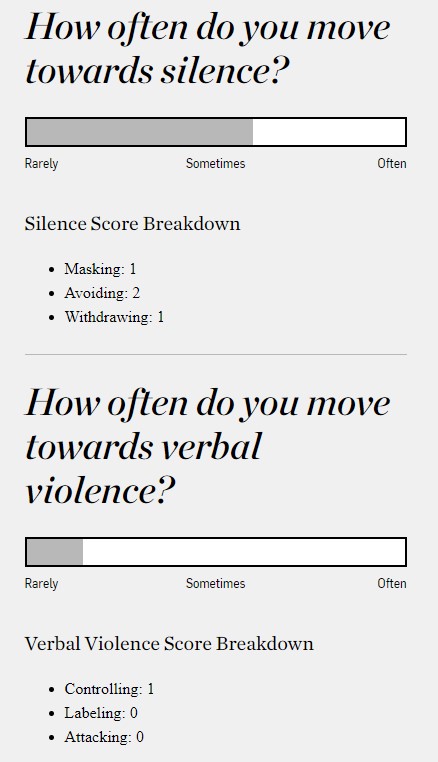
The book’s authors offer additional resources, one of which is to determine your Style Under Stress.
I found these results and the examples from Crucial Conversations very revealing. I know I avoid and withdraw when conflict or disagreement arises, but I would never have self-assessed “controlling” in the violence category.
I will have to be mindful of these tendencies and stop to:
Spot Crucial Conversations (physical/behavioral signs or emotions)
Look for Safety Problems (both what and why)
Make it Safe
Throughout the development of my Influencer Strategy and by creating a 4DX Plan, there has been no doubt about how important accountability is to motivation, morale, and the success of a change strategy. Therefore, I must create safety so communication and innovation can flow freely among team members. I must be observant and aware when the team is engaged in dialogue and when it is not. Committing to actively engage in crucial conversations when dialogue stops cultivates accountability throughout the advising unit. The process outlined by Crucial Conversations will help as we move through the implementation of an advising innovation. These conversations will also help us grow and evolve with multiple perspectives, points of view, and, most importantly, understanding and respect for one another. Crucial conversations “teaches direct and respectful ways to express [my] thoughts” (Vital Smarts India, 2012) and to “reestablish mutual purpose and mutual respect” (Patterson et al., 2012, pp. 76-82) when the dialogue becomes threatened. The authors challenge me to assess whether others know I care about their goals and trust my motives. I sincerely hope that sharing my why will help me establish a mutual purpose (Patterson et al., 2012, p. 77) from which we can build and recover when conversations become crucial. This communication strategy will be valuable to this change initiative since maintaining mutual respect is the only way to stay in dialogue. It is empowering to help equip every team member with the skills needed to effectively move forward in dialogue through difficult and stressful situations like those we will face as emotions run high.
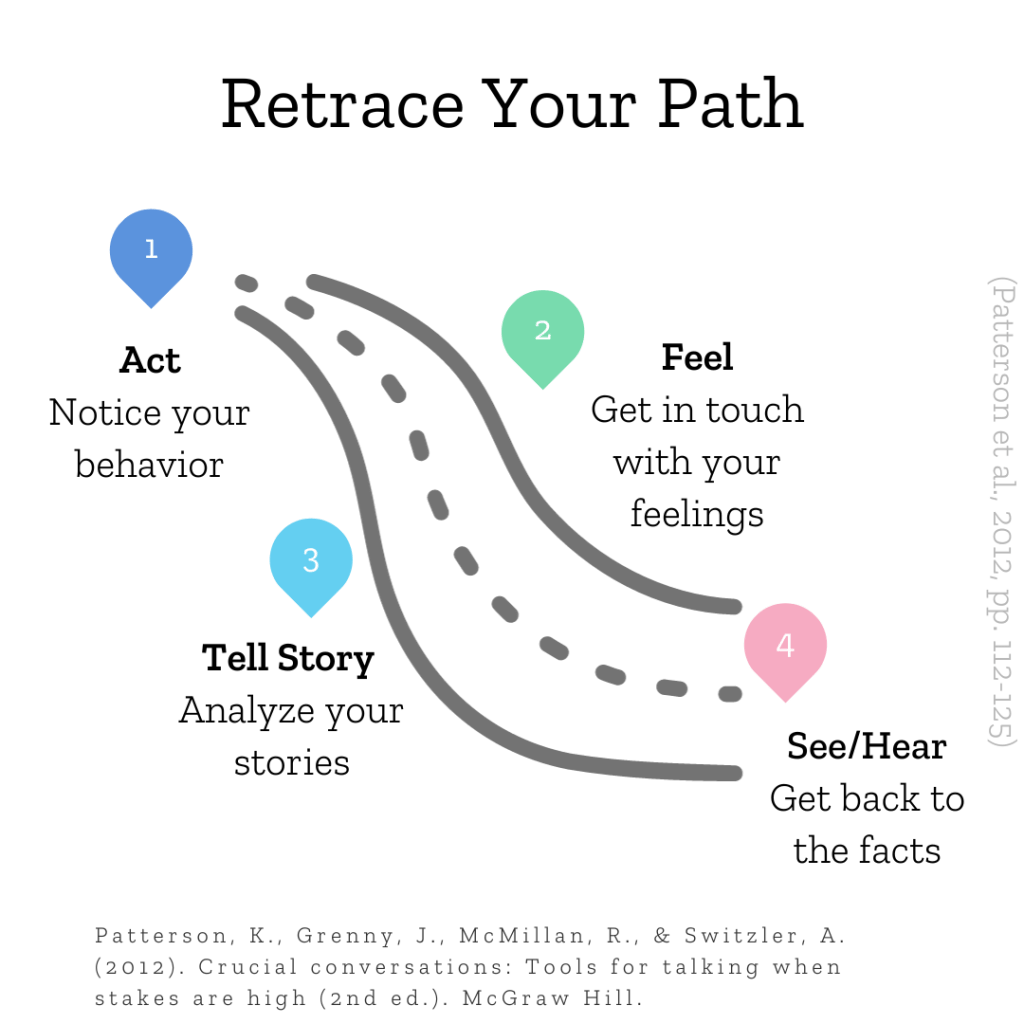
The chapter on mastering my stories is one of the most valuable aspects of the crucial conversation strategy to my reflection. The facts outlined about how only I can be responsible for my emotions and how I respond to them will be helpful as I inevitably meet resistance at different stages of implementation. The steps outlined for the “Path to Action” have given me much perspective on how I perceived situations and interactions from my professional past. I can now evaluate how the stories I created surrounding past conversations are responsible for how I felt about those interactions. Indeed, the cumulative effect of those stories and emotions eventually led me to leave those positions. Undoubtedly, the authors’ “skills for mastering our stories” will prove helpful as I evolve into a self-differentiated leader and as our team works and collaborates. As the advising team moves forward through our innovation of advising, these skills can equip us to have crucial conversations that will allow our efforts to be effective and our relationships to grow stronger.
Following the path to action and retracing the steps help with personal awareness and more control over our emotions.
STATE my Path
Everything up until this point helps to prepare to engage in crucial conversations. The steps and processes help to ensure that we are clear on our motives, purposes, perceptions, and perspectives as we finally begin to engage in dialogue. Striking a balance between open honesty and respectful humility is something the best at dialogue can do.
In step 3 of STATE-ing our path, we ask for others’ points of view and genuinely listen to receive their input or perspective. To do this, we must explore others’ paths. At times we will be in situations where we must navigate rocky waters, like when others are expressing silence or violence. We must acknowledge that just as we tell ourselves stories and make individualized interpretations and understandings of others’ words and actions, others do the same about ours. Therefore, I must be transparent about mistakes, aware of emotions, interpretations, and verbal/non-verbal messages, communicate my intentions clearly, and apologize when they are not. It is humbling and powerful to require leaders and team members to check themselves when they find themselves out of line and to demand that they admit and own those errors in judgment or temper.
Start with Heart
Suppose we work to sincerely and patiently listen to another’s experience. In that case, we can openly and curiously explore how others are feeling, what they are thinking, and how we can help restore safety so that dialogue can continue (Patterson et al., 2012, p. 157). Just as we have done in our preparation for crucial conversations, we can encourage others to follow the five steps outlined above to retrace them together to develop our crucial conversation skills.
Use Inquiry Skills
When?
When silence or violence begins, it is time for us to step out of the conversation and establish safety so that we can get to the source of the emotions causing others to stop dialoguing.
How?
Patterson et al. (2012) state, “We must be genuine in the face of hostility, fear, or even abuse” (p. 162).
What?
Make it safe for others to be vulnerable about their feelings and truly listen to what they are saying.
Work to be sure that dialogue continues and is not interrupted by minor details. Focus on the areas of agreement to grow and evolve from as a starting point.
Build:
Actively search for points of common ground on which to build. By starting a dialogue with the areas of agreement, you open space to create discussion and understanding.
Compare:
Share how your perspective differs from the other person and use that conversation about your facts, stories, and emotions to explore how each of you sees the options up for discussion, which is much more effective than simply declaring that you are right the other person is wrong. You can disagree and still hold valuable dialogue.
Move to Action
Now that we have been actively working on practicing strong dialogue skills, we must follow through to the action steps derived from those discussions. Once again clarity is key to this phase of the dialogue strategy which helps convert crucial conversations into both results and action.
How are decisions going to be made?
If people have differing views on how the decision will be made, there could be miscommunications and misunderstandings, eroding the trust built throughout the dialogue.
Are we ever going to decide?
This condition occurs when there are too many options or maybe no solutions after dialogue and meaning are explored. This condition leaves everyone playing a game of not it wondering if anything will ever happen.
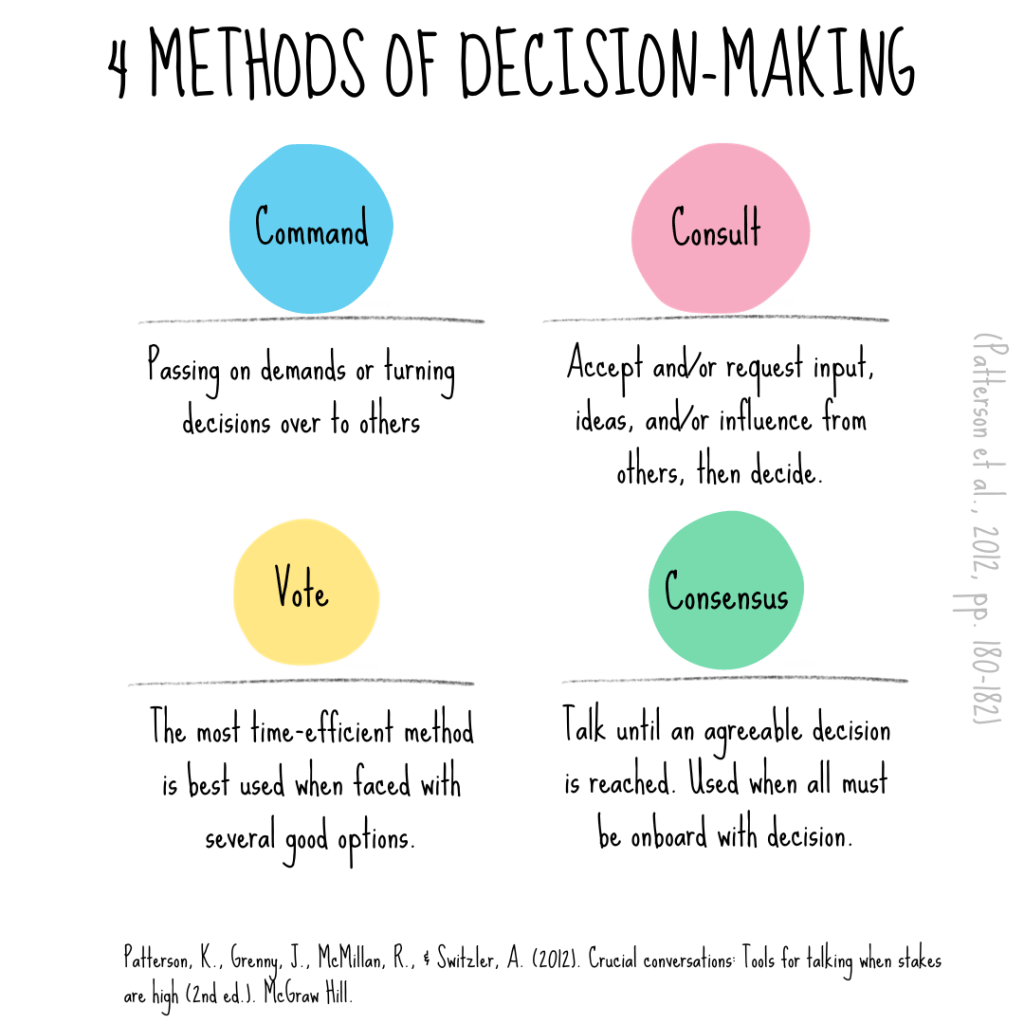
Decide How to Decide
“To avoid violated expectations, separate dialogue from decision making. Make it clear how the decision will be made – who will be involved and why” (Patterson et al., 2012, p. 179) before starting a dialogue. When the line of authority is clear, the manager will be the decision maker. When the line of authority is unclear, identifying the decision-maker can be more challenging because a dialogue will be needed to identify who will decide collectively.
Consider who on the team has an invested interest and truly desires to be a part of the decision-making. There is a better time to push for involvement from those who don’t.
Who knows?
Think about the team members with experience or special skills that would add beneficial knowledge to the decision-making process.
Who must agree?
Get ahead of the opposition. Consider all the players for whom you will need to obtain acceptance and involve them in the decision-making process.
How many people is it worth involving?
“Involve the fewest number of people while still considering the quality of the decision along with the support that people will give it” (Patterson et al., 2012, p. 183).
“Assign a name to every responsibility” (Patterson et al., 2012, p. 184) to avoid confusion or a general lack of progress due to ambiguity.
Does what?
Review, reanalyze, and compare your vision with the understanding of those assigned to carry it out. Very clearly outline each aspect of your expectations.
By when?
The 4 Disciplines of Execution (4DX) clearly explain the fury of the day-to-day whirlwind. If deadlines are not communicated, then that urgency will inevitably cause our plans to be pushed to an undefined date, likely never to be complete.
How will you follow up?
Accountability is key to success in the Influencer Strategy through its measures of success and the 4DX Plan through a compelling scoreboard. Therefore, it is essential to build specific and time-sensitive follow-ups into the action steps outlined.
“Write down details of conclusions, decisions, and assignments. Remember to record who does what by when” (Patterson et al., 2012, p. 187) and keep your team members accountable. With all these skills combined, we can finally recognize that it is possible to heal from past hurts and become skilled, proficient, and comfortable holding high-stakes dialogues even when situations are uncomfortable so that together, we can innovate advising.
References
Patterson, K., Grenny, J., McMillan, R., & Switzler, A. (2012). Crucial conversations: Tools for talking when stakes are high (2nd ed.). McGraw Hill.











 The Advisor That Cares