Action Research, ADL Program, Advising, Evolution, Goals, Growth, Growth Mindset, Humor, Learner's Mindset, Learning, Personal, Reflecting, Research

Am I a researcher?


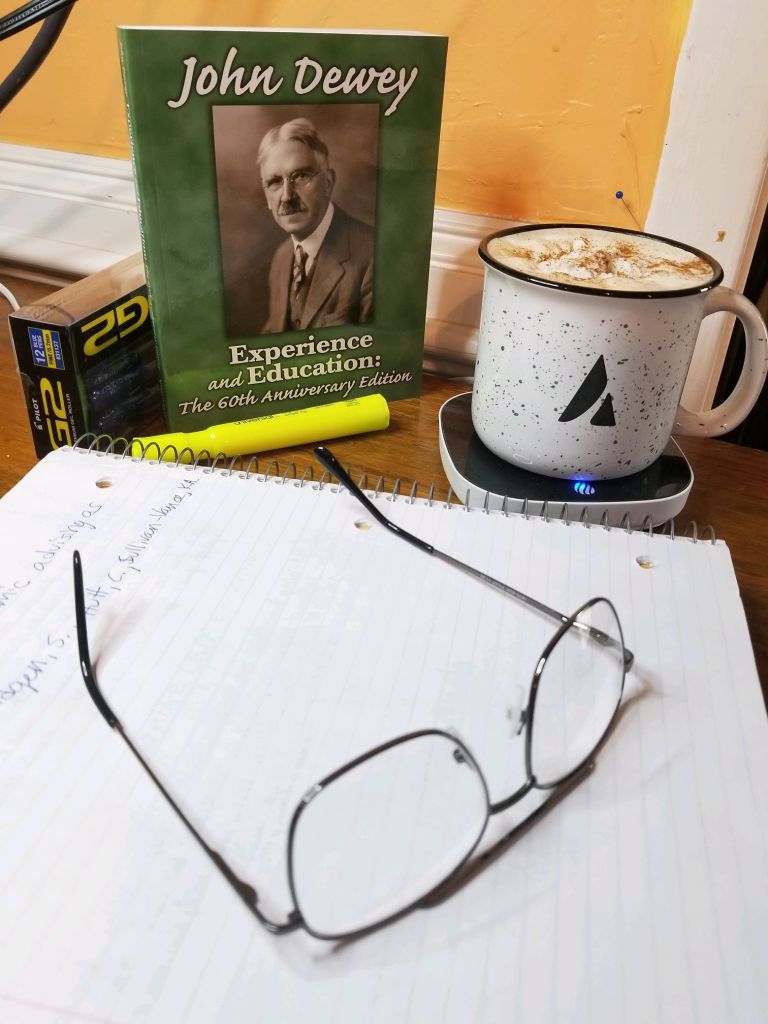
Image of authors workspace. A pair of reading glasses is resting on a spiral notebook with a background of a full box of pens, a highlighter, John Dewey's book, and a cup of cream topped coffee sits on a coffee warmer.

The strangest thing is beginning to happen. As I read literature, I recognize authors I have previously read, cited, and studied. This recognition of source material is a very entertaining phenomenon as I am reviewing and searching for new resources and information on my innovation topic.

Action Research, ADL Program, Advising, ePortfolios, Goals, Growth, Growth Mindset, Influencer, Innovation Plan, Leadership, Learner's Mindset, Learning, Personal, Professional, Professional Learning, Reflecting, Research

Relevant Research


So I really feel like I have been on a quest for precisely the type of information I just found.

Transformations in academic advising as a profession

For the first time, I have found a recent piece of literature that connects directly to the goals of my innovation plan. Let me see if I can explain this connection and my excitement at finding it.  

I struggle to accurately explain why an innovation involving blended learning (Horn & Staker, 2017) could revolutionize advising. An advising innovation will impact students and advisors at my institution for all reasons cited in this body of work.

My innovation plan seeks to create more time and comfortable space within advising appointments for meaningful interactions (Troxel et al., 2021). Until we find an effective way to get the course registration and degree plan requirements out of the way, advising will continually miss potentially life-altering opportunities. 


My action research study will utilize a quantitative design to narrowly focus on any correlation between study agency over accurate course registration and a blended learning advising module on the same topic. 

  • Variable one:
    • blended learning advising module covering how and where to find degree plan requirements, degree progression plans, course registration procedures, and other registration-related tasks such as holds, balances, or action items needed for course registrations. 
  • Variable two: 
    • Student agency, as evidenced by the ability to outline course plans accurately and effectively before the advising session for the upcoming registration period. 

Methods:

  • Student pre-advising Likert and Likert-like questions regarding upcoming course registration, advising module information, and overall perceptions of readiness for next semester’s course registration
  • Advisor post-advising Likert and Likert-like questions regarding the accuracy of course selections made by the student, the quality of questions students ask during advising sessions and the advisor’s perceptions of the student’s preparedness for course registration. Advisors will rank the accuracy of registration plans and relevance to the student’s degree program. Finally, advisors will rate the overall advising interaction and depth of conversation. 

References

Horn, M. B., & Staker, H. (2017). Blended: Using disruptive innovation to improve schools. John Wiley & Sons.

Troxel, W. M., Bridgen, S., Hutt, C., & Sullivan‐Vance, K. A. (2021). Transformations in academic advising as a profession. New Directions for Higher Education, 2021(195–196), 23–33. https://doi.org/10.1002/he.20406

Learning, Research

Educause – Life


I pulled a few favorite quotes while reading Educause – 2022 Students and Technology Report: Rebalancing the Student Experience. I don’t have time to fully articulate my thoughts and connections to my learning, but I don’t want to lose the valuable nuggets that resonated with me. I will post here in hopes of returning to process those connections.

In addition to these institutional barriers, respondents described a number of nonacademic circumstances that hinder their success:

  • Work schedules
  • Time management, especially related to work/life balance
  • Confidence, self-esteem, focus, and motivation
  • Availability of transportation
  • Time spent commuting
  • Family caretaking responsibilities
  • Mental and physical health

Understanding the barriers students face from both institutional and nonacademic situations will help institutional leaders design and redesign support systems, curricula, and learning environments.

(2022 Students and Technology Report: Rebalancing the Student Experience, 2022)

Ask your students how they define a successful experience at your institution so that you can support more than just degree completion, and evaluate institutional policies and practices to determine which ones are helping students succeed and which ones are acting as barriers to success. Integrate students’ ideas when you create new support programs.

(2022 Students and Technology Report: Rebalancing the Student Experience, 2022)

Students are whole people with complex learning needs and goals. Completing a degree is the most common way respondents defined a successful higher education experience, but they are also hoping to secure a job, achieve personal growth, secure a high salary, and more.

(2022 Students and Technology Report: Rebalancing the Student Experience, 2022)

Reference

2022 Students and Technology Report: Rebalancing the Student Experience. (2022, October 3). EDUCAUSE. Retrieved October 3, 2022, from https://library.educause.edu/resources/2022/10/2022-students-and-technology-report-rebalancing-the-student-experience?utm_source=Selligent&utm_medium=email&utm_campaign=report_workforce&utm_content=10-03-22&utm_term=_&m_i=gOxoTDKsSnuYNHpF5gYO7fCAQ7f4aHQ4dZIY9A9VdW_T7Y2lbkDcdYEJl4D_fBvjOXq6OEpO6aQnIFFamAp6GfDDl77T9Ugggg&M_BT=88967532832