“A call to passion” is exactly what Developing Effective Professional Learning means to me. I am so excited to share professional learning with each of you! We have the overwhelming honor of helping others utilize their passions through the adventure of learning. Together.
As a student, beginning a new chapter of life can be overwhelming. You are an adult, which you have been looking forward to for as long as you can remember. But you are also stepping outside of your comfort zone. Really finding yourself. Discovering who you want to be without the primary inputs that previously surrounded you.
As advisors, we are honored to help guide students as they begin University life. My research shows that the advising relationship is significant to students’ perseverance through what can be a challenging adjustment. Nevertheless, how many times has this significance escaped you? How often have you felt like a broken record? How exhausting can it be for you and the student as you frantically attempt to cover so many things? Just a few examples come to mind like the university’s policies and procedures; system access and onboarding; information about the program, department, and academic college; outlining course options, prerequisite sequences, and electives selections; confirming career goals for major alignment, not to mention informing students of the multiple support resources and offices across campus. How often do we find ourselves desperately trying to get to know our students on the walk to our office or in the brief moments before or after the information download I just described? When are we supposed to find that moment to connect with them so that we can help them make meaning of their learning, struggles, and opportunities to grow?
We can embrace professional learning by moving away from the current professional development model. We can find personal relevance and engage passions as our mission resonates. Doing so requires that our support be ongoing. We want to give good training, but don’t want to stop there. We want to build teams with peer coaching that happens throughout implementation. We can encourage active engagement, and we can model our new skills. As we do these things, we will see an increase in adaptability to our specific situations and even more adoption of our innovation. We need frequent communication to know what is working and what needs improvement.
As we embrace this new professional learning model, we will find success in addressing challenges, improving delivery methods, and creating time and space for advisors to do what they do best, connect with students.
The most wonderful aspect of the ADL program is constant reflection. As I sit here trying to identify a professional learning opportunity, what aspect of my innovation ideas to begin with, how to introduce my ideas to my audience, and so much more, I have once again challenged myself to re-identify my audience and re-examine my why.
Living the learner’s mindset means that even though it would be easy to tell myself I have already done the work on both topics, this is an ever-evolving process of “higher-order thinking” and “meaning-making.” Precisely the objectives of this program, the objectives of learning, and the objectives when teaching.
The theme that always resonates throughout this process for me is authenticity. I am attempting to share my heart with the world. I strive to find, refine, and articulate my passion for helping others. As I check my notes on the research I’ve recently reviewed regarding professional development and the 5 Principles of Professional Learning (Guluamhussein, 2013), it is the ACT/ACTION part of the learning process that particularly resonates with me.
You see, learning wasn’t easy for me. Wait, let me rephrase that. Education wasn’t easy for me. I was lost and behind most of the time. I received low grades and had very low self-esteem due to tying my personal worth to other people’s approval. I spent my early adulthood being taken advantage of due to an overwhelming need to people-please. At one point, I had three adult friends living in a three-bedroom apartment with me while I was the only one working, paying bills, buying groceries, and cleaning.
If these same principles had been applied in my learning journey, I would have had more prolonged exposure to new concepts. Instead of exponentially falling behind, I would be bolstered by significant assistance. I was constantly missing the aspects of understanding needed to transfer the information from the lessons into learning. As a result, almost everything seemed irrelevant and out of reach.
Here is a fun example of exactly what I mean about active, ongoing, thought-provoking learning. See if you can make it all the way to the reflective/active learning part.
Now as a catalyst for change, I want to do better for others. I want to make learning meaningful and relevant to them. As a leader, I want to support my team through changes. I want to model the ways that I hope they will, in turn, support their teammates and students.
Reference
Gulamhussein, A. (2013). Teaching the Teachers: Effective Professional Development in the Era of High Stakes Accountability. National School Board Association, Center for Public Education.
In a previous post, I worked to identify what I must address to become a self-differentiated leader. With the knowledge that change initiatives can be anxiety-producing for many people, it will be essential to have a clear plan. As a self-differentiated leader, I must be committed to my purpose to stand firm in my goals and strategies. To be effective at holding crucial conversations, I must be willing to consider an outside view of myself.
Crucial Conversations teaches that we must first deal with ourselves to evaluate our motives. We must assess ourselves to focus on what we want while maintaining our bearings on the original purpose of the dialogue. We must be able to keep our brains engaged by asking complex questions to present new choices to regain safety and re-engage in dialogue.
Since all change begins with me, I must first stop to ask myself the following questions:
What do I want for myself?
What do I want for others?
What do I want for the relationship?
Action Prompt: How would I behave if I wanted these results?
These three questions and action prompts can foster healthy, open communication and a collaborative work environment. After working in unhealthy environments in the past, I aspire to help create a healthy and productive one.
Learn to Look
As I work to create an environment that encourages these healthy conversations, I must also be diligent in observing myself and the team as we move through this innovation to advising together. I must watch for the signs when individuals either resort to (silence) by “purposefully [withholding] information from the pool of meaning” or (violence) “by trying to force meaning into the pool” (Patterson et al., 2012, pp. 58-61). With safety problems or when dialogue stops and conversations become crucial, the human brain switches from a source of rational reasoning to one of fight or flight. We can reactivate the rational brain and help bypass this evolutionary response to hold effective dialogues by working and learning to engage through questions. This process of asking myself what I want to get out of a conversation allows me to check my tendencies toward silence or violence.
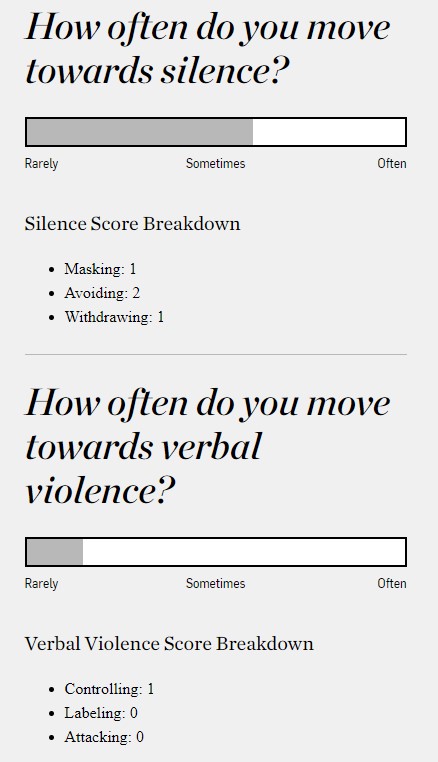
The book’s authors offer additional resources, one of which is to determine your Style Under Stress.
I found these results and the examples from Crucial Conversations very revealing. I know I avoid and withdraw when conflict or disagreement arises, but I would never have self-assessed “controlling” in the violence category.
I will have to be mindful of these tendencies and stop to:
Spot Crucial Conversations (physical/behavioral signs or emotions)
Look for Safety Problems (both what and why)
Make it Safe
Throughout the development of my Influencer Strategy and by creating a 4DX Plan, there has been no doubt about how important accountability is to motivation, morale, and the success of a change strategy. Therefore, I must create safety so communication and innovation can flow freely among team members. I must be observant and aware when the team is engaged in dialogue and when it is not. Committing to actively engage in crucial conversations when dialogue stops cultivates accountability throughout the advising unit. The process outlined by Crucial Conversations will help as we move through the implementation of an advising innovation. These conversations will also help us grow and evolve with multiple perspectives, points of view, and, most importantly, understanding and respect for one another. Crucial conversations “teaches direct and respectful ways to express [my] thoughts” (Vital Smarts India, 2012) and to “reestablish mutual purpose and mutual respect” (Patterson et al., 2012, pp. 76-82) when the dialogue becomes threatened. The authors challenge me to assess whether others know I care about their goals and trust my motives. I sincerely hope that sharing my why will help me establish a mutual purpose (Patterson et al., 2012, p. 77) from which we can build and recover when conversations become crucial. This communication strategy will be valuable to this change initiative since maintaining mutual respect is the only way to stay in dialogue. It is empowering to help equip every team member with the skills needed to effectively move forward in dialogue through difficult and stressful situations like those we will face as emotions run high.
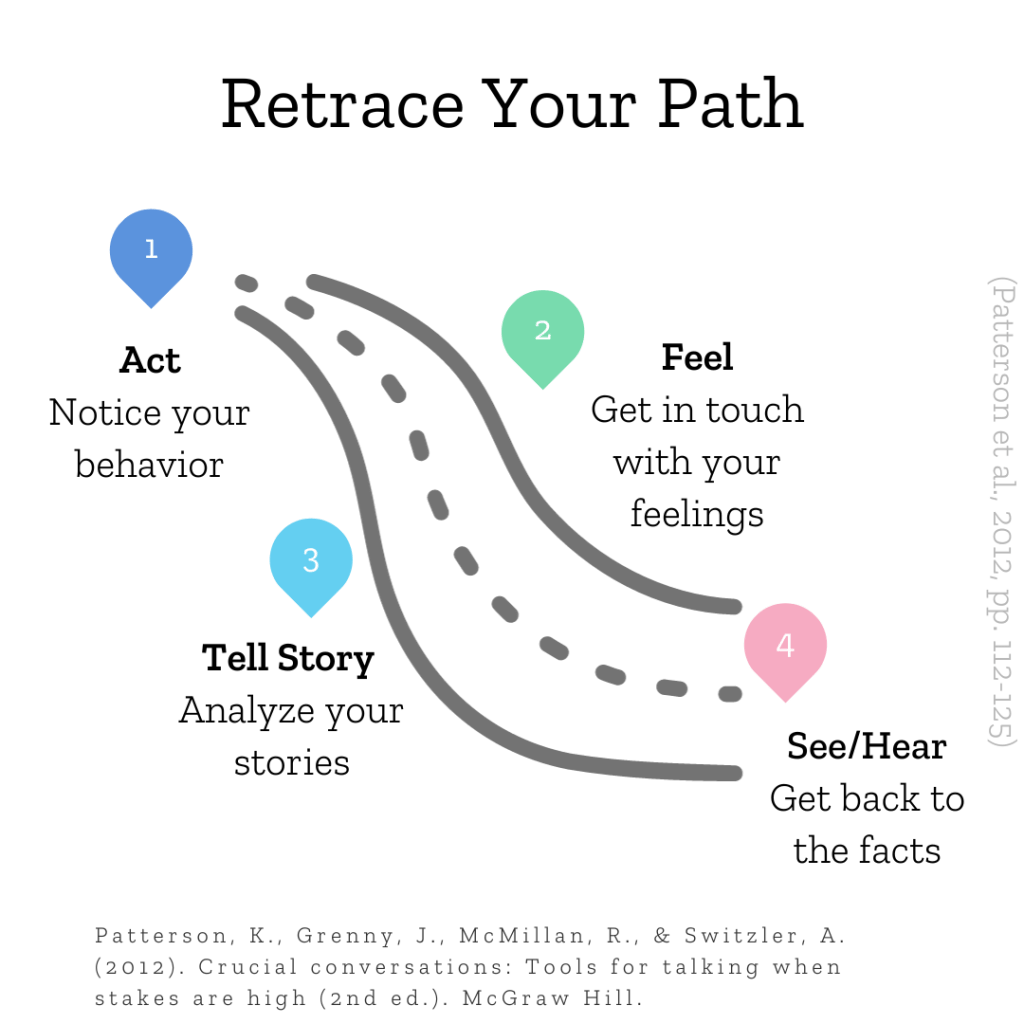
The chapter on mastering my stories is one of the most valuable aspects of the crucial conversation strategy to my reflection. The facts outlined about how only I can be responsible for my emotions and how I respond to them will be helpful as I inevitably meet resistance at different stages of implementation. The steps outlined for the “Path to Action” have given me much perspective on how I perceived situations and interactions from my professional past. I can now evaluate how the stories I created surrounding past conversations are responsible for how I felt about those interactions. Indeed, the cumulative effect of those stories and emotions eventually led me to leave those positions. Undoubtedly, the authors’ “skills for mastering our stories” will prove helpful as I evolve into a self-differentiated leader and as our team works and collaborates. As the advising team moves forward through our innovation of advising, these skills can equip us to have crucial conversations that will allow our efforts to be effective and our relationships to grow stronger.
Following the path to action and retracing the steps help with personal awareness and more control over our emotions.
STATE my Path
Everything up until this point helps to prepare to engage in crucial conversations. The steps and processes help to ensure that we are clear on our motives, purposes, perceptions, and perspectives as we finally begin to engage in dialogue. Striking a balance between open honesty and respectful humility is something the best at dialogue can do.
In step 3 of STATE-ing our path, we ask for others’ points of view and genuinely listen to receive their input or perspective. To do this, we must explore others’ paths. At times we will be in situations where we must navigate rocky waters, like when others are expressing silence or violence. We must acknowledge that just as we tell ourselves stories and make individualized interpretations and understandings of others’ words and actions, others do the same about ours. Therefore, I must be transparent about mistakes, aware of emotions, interpretations, and verbal/non-verbal messages, communicate my intentions clearly, and apologize when they are not. It is humbling and powerful to require leaders and team members to check themselves when they find themselves out of line and to demand that they admit and own those errors in judgment or temper.
Start with Heart
Suppose we work to sincerely and patiently listen to another’s experience. In that case, we can openly and curiously explore how others are feeling, what they are thinking, and how we can help restore safety so that dialogue can continue (Patterson et al., 2012, p. 157). Just as we have done in our preparation for crucial conversations, we can encourage others to follow the five steps outlined above to retrace them together to develop our crucial conversation skills.
Use Inquiry Skills
When?
When silence or violence begins, it is time for us to step out of the conversation and establish safety so that we can get to the source of the emotions causing others to stop dialoguing.
How?
Patterson et al. (2012) state, “We must be genuine in the face of hostility, fear, or even abuse” (p. 162).
What?
Make it safe for others to be vulnerable about their feelings and truly listen to what they are saying.
Work to be sure that dialogue continues and is not interrupted by minor details. Focus on the areas of agreement to grow and evolve from as a starting point.
Build:
Actively search for points of common ground on which to build. By starting a dialogue with the areas of agreement, you open space to create discussion and understanding.
Compare:
Share how your perspective differs from the other person and use that conversation about your facts, stories, and emotions to explore how each of you sees the options up for discussion, which is much more effective than simply declaring that you are right the other person is wrong. You can disagree and still hold valuable dialogue.
Move to Action
Now that we have been actively working on practicing strong dialogue skills, we must follow through to the action steps derived from those discussions. Once again clarity is key to this phase of the dialogue strategy which helps convert crucial conversations into both results and action.
How are decisions going to be made?
If people have differing views on how the decision will be made, there could be miscommunications and misunderstandings, eroding the trust built throughout the dialogue.
Are we ever going to decide?
This condition occurs when there are too many options or maybe no solutions after dialogue and meaning are explored. This condition leaves everyone playing a game of not it wondering if anything will ever happen.
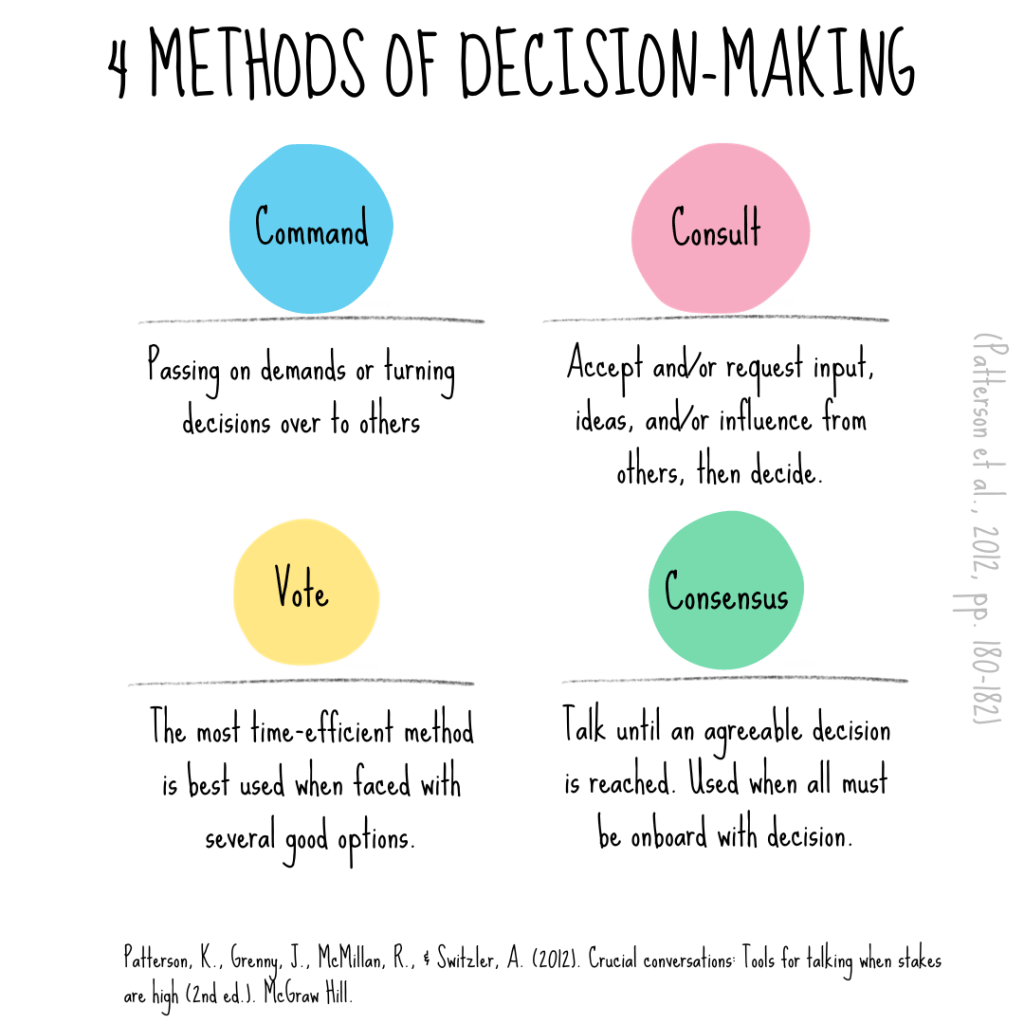
Decide How to Decide
“To avoid violated expectations, separate dialogue from decision making. Make it clear how the decision will be made – who will be involved and why” (Patterson et al., 2012, p. 179) before starting a dialogue. When the line of authority is clear, the manager will be the decision maker. When the line of authority is unclear, identifying the decision-maker can be more challenging because a dialogue will be needed to identify who will decide collectively.
Consider who on the team has an invested interest and truly desires to be a part of the decision-making. There is a better time to push for involvement from those who don’t.
Who knows?
Think about the team members with experience or special skills that would add beneficial knowledge to the decision-making process.
Who must agree?
Get ahead of the opposition. Consider all the players for whom you will need to obtain acceptance and involve them in the decision-making process.
How many people is it worth involving?
“Involve the fewest number of people while still considering the quality of the decision along with the support that people will give it” (Patterson et al., 2012, p. 183).
“Assign a name to every responsibility” (Patterson et al., 2012, p. 184) to avoid confusion or a general lack of progress due to ambiguity.
Does what?
Review, reanalyze, and compare your vision with the understanding of those assigned to carry it out. Very clearly outline each aspect of your expectations.
By when?
The 4 Disciplines of Execution (4DX) clearly explain the fury of the day-to-day whirlwind. If deadlines are not communicated, then that urgency will inevitably cause our plans to be pushed to an undefined date, likely never to be complete.
How will you follow up?
Accountability is key to success in the Influencer Strategy through its measures of success and the 4DX Plan through a compelling scoreboard. Therefore, it is essential to build specific and time-sensitive follow-ups into the action steps outlined.
“Write down details of conclusions, decisions, and assignments. Remember to record who does what by when” (Patterson et al., 2012, p. 187) and keep your team members accountable. With all these skills combined, we can finally recognize that it is possible to heal from past hurts and become skilled, proficient, and comfortable holding high-stakes dialogues even when situations are uncomfortable so that together, we can innovate advising.
References
Patterson, K., Grenny, J., McMillan, R., & Switzler, A. (2012). Crucial conversations: Tools for talking when stakes are high (2nd ed.). McGraw Hill.
Effective leadership requires the leader to be self-aware and clear on their motivations. To effectively lead, one must “develop the characteristics of a self-differentiated leader so that you can have the stamina and resolve to keep moving forward in the face of resistance” (Dwayne Harapnuik, 2021). Becoming a self-differentiated leader demands one to remain in touch with their driving purpose and the proposed change.
The most appealing aspect of self-differentiated leadership is the ability to remain connected to the team while staying true to the purpose and plan. Fortified against the virus-like triangulation and sabotage that surface from anxiety and insecurity, a self-differentiated leader can stand firm, lending stability from within. While working to help team members accept personal responsibility for their discomfort with change, a self-differentiated leader can listen and provide support without adopting the team’s anxiety.
Just like a self-differentiated cell in the body knows its purpose and function, becoming a self-differentiated leader allows me to foster and lead change without being influenced or stressed by the response of those around me. It is humbling to think that I can learn, practice, and evolve into a self-differentiated leader who creates the climate for healthy and effective organizational changes. I would love to be the change agent that provides my team members with happier, healthier, and more productive lives.
Since my goal is to develop and implement innovative changes, I must utilize each tool in my ADL Program toolbox and embark on the crucial conversations needed to get the change process underway.
Swan Hill Youth Mental Health Project. (2015, August 12). Friedman’s Theory of Differentiated Leadership Made Simple [Video]. YouTube. https://www.youtube.com/watch?v=FaifIIeQC9k
Put simply, care. Care about students. Care about advisors. Care about departments. Care about program and state requirements. Care about policies. Ultimately, care about changing lives.
… how vital the role of a strong advising relationship is to students’ retention and success. Providing students with 24/7 access to personally curated information resources can guide them throughout their programs’ completion. This innovation aims to improve the experience for both advisors’ and students’ while strengthening that relationship.
Guiding students to find or reconnect with a passion for learning and to make meaningful connections throughout their learning experience on the way to becoming life-long inquisitive learners.
Helping advisors find their purpose and joy in helping others by helping them overcome challenges and valuing their input as change agents.
… my purpose is to make a difference in other people’s lives.
Grenny, J., Patterson, K., Maxfield, D., McMillan, R., & Switzler, A. (2013). Influencer: The New Science of Leading Change, Second Edition. McGraw-Hill Education.
Jeni Cross does a great job of outlining that common sense ideas are often antithetical to behavior change in her TEDxTalk. I found Myth #1 interesting. This first common sense myth believes that education or information will change behavior. In this example, the speaker gave a compelling perspective on how we must present information to influence behavior change. The speaker illustrates that we can learn from social science to affect change by making personalized and tangible information for a more significant impact. To do so, “knowing your audience is a key factor in change” (TEDx Talks, 2013a). The recommendation to “frame loss, not gains” was a surprising shift in perspective. Common sense might say to outline and highlight everything an organization will gain from a change strategy but “hearing what you are losing is more motivating than hearing what you are gaining” (TEDx Talks, 2013a). Common sense, myth #2 states that you must address and change attitudes to change behavior, but the speaker illustrates that attitudes follow behavior, not predict it. Therefore, you can avoid fighting to change attitudes by connecting values to behavioral expectations. You instead set expectations. Myth #3 about common sense says social interaction, pressure, and modeling are some of the most significant influences on motivation. An effective way to enact change is to connect behaviors to issues about which people care to “make the change meaningful” (TEDx Talks, 2013a).
The vital behaviors outlined by Joseph Greeny align with many of the cautions proposed by Jeni Cross. For example, Greeny’s first source of influence, personal motivation, sounds like the personalized social interaction defined by Jeni Cross. Creating that tangible presentation helps to increase urgency around the reasons for change. Myth 2 about attitudes and expectations sounds like the vital behaviors identified by Greeny. Lastly, change agents identified by Greeny tie directly to the social norms and modeling outlined in meaningful change efforts by Cross.
The results I wish to achieve through the Innovation to Advising is to equip students with the knowledge and information needed to make informed decisions. The goal is to do this while simultaneously relieving advisors of the repetitive, prescriptive, and informational components of advising to create space for advisor-advisee relationship building and meaning-making through reflection on what is working and what could be better.
References
TEDxTalks. (2013a, March 20). Three myths of behavior change – what you think you know that you don’t: Jeni Cross at tedxcsu. YouTube. Retrieved from https://www.youtube.com/watch?v=l5d8GW6GdR0
This post is the first step in developing an influencer strategy that can help in the Innovation of Advising, which empowers students and advisors in creating authenticity in the advising relationship.
Identify Results
Transform transactional advising general information and onboarding orientation to video, audio, and text resources in flipped advising modules with digital assessments by the Fall 2025 intake cycle.
Measurement
Measurement efforts can utilize typical question/quiz formats for transactional pieces of advising to clear various holds and satisfy specific enrollment requirements.
Further and ongoing assessments
Open-ended feed-forward monthly one-minute (what’s working/what can be better?) check-ins with students and advisors. Results open the door for collaboration opportunities that improve, clarify and streamline online resources for various readers, levels, and delivery modes and preferences.
Satisfaction surveys for advisors to express bottlenecks and pinch-points described by students. 30-minute weekly advisor check-ins to discuss and brainstorm for solution-oriented collaborative groups from across campus support (admissions, financial aid, IT, records) that provide solution-based improvement ideas as front-line interaction experts.
Departmental Likert surveys to obtain valuable and informative data metrics at targeted assessment points (two-three times during each semester). An example is an informational Tik-Tok campaign about the impact of dropping and currently available (live) resources/support services around significant drop deadlines. Followed by a “did this information help you” survey to assess growth mindset messaging‘s and support service referrals’ impact on retention/student success.
Site visit statistics used to track resource utilization during targeted campaigned proactive outreach.
Vital Behaviors you are trying to change
Create and allow for flexible advising options (online, e-advise, module/quiz-based, video/quiz-based, in-person), allowing for the ultimate diversity of choice, ownership, and voice for each learner and advisor within accepted and set boundaries/expectations. This vital behavior empowers and frees students and advisors from mandated expectations of advising interactions to express their individuality while contributing to the collaboration of compelling flipped advising opportunities.
Advising modules can include internal triggers to direct students’ needs based on assessments from within advising modules. Answers/scores can launch informative videos, initiate a referral to support services (Careers, ARC, advising, financial aid/scholarships), targeted outreach, and follow up from stakeholders to explain options and impacts and/or advising/coaching campaign links. During peak advising/registration times, outreach efforts/campaigns will direct students to flipped advising resources. This action leaves advisors’ schedules open and available during critical availability timeframes.
Cultural/Organizational Influencers and Why
Advisors will be one of the most significant cultural influences in this change strategy because they have the front-line perspective of students’ frustrations and confusion. This innovation will empower advisors to help improve the student experience while reducing the repetitive and transactional calls, emails, and appointments that prevent them from more meaningful interactions with students.
Stakeholders will be another source of significant cultural influence in the transformation of advising as it encompasses and overarches all offices and services of the university structure (such as the records department; scholarship, financial aid, and veterans affairs; system administrators; technology support, service desk, and instructional designers; administrative support).
Put simply, care. Care about students. Care about advisors. Care about departments. Care about program and state requirements. Care about policies. Ultimately, care about changing lives.
… how vital the role of a strong advising relationship is to students’ retention and success. Providing students with 24/7 access to personally curated information resources can guide them throughout their programs’ completion. This innovation aims to improve the experience for both advisors’ and students’ while strengthening that relationship.
Guiding students to find or reconnect with a passion for learning and to make meaningful connections throughout their learning experience on the way to becoming life-long inquisitive learners. Helping advisors find their purpose and joy in helping others by helping them overcome challenges and valuing their input as change agents.
… my purpose is to make a difference in other people’s lives.
Who do our students want to become? Who do our advisors want to help them become? What motivates our advisors to come and guide students? How does each impact the lives of our students and advisors? (CSLE2COVA, 2018)
Grenny, J., Patterson, K., Maxfield, D., McMillan, R., & Switzler, A. (2013). Influencer: The New Science of Leading Change, Second Edition. McGraw-Hill Education.
Apple’s call to Think Differently states, “the people who are crazy enough to think they can change the world are the ones who do” (Harry Piotr, 2013).
“[I] see things differently, [I am] not fond of rules, and [I] have no respect for the status quo” (Harry Piotr, 2013).
Help me change the world.
Why: By genuinely caring about others and desiring to make a difference, I believe innovation in advising will equip and empower students as they become lifelong learners by helping them identify growth opportunities.
How: Enabling learners to embrace choice, ownership, and voice by modeling an authentic learning environment in advising creates the foundation for students to take control, be active participants, and make meaning out of their learning experiences.
What: Students become self-directed learners who have confidence in their ability to successfully navigate various challenges, circumstances, and opportunities throughout their life far beyond graduation.
I do what I do because I care about people. Therefore, I can honestly say that my why is at the heart of my innovation plan. You see, my purpose is to make a difference in other people’s lives. I “want to transform [my] learners’ lives and change their world” (Dwayne Harapnuik, 2019). My motivation is to improve the advising experience for students (and advisors) while believing they deserve the opportunity to experience choice, claim ownership, and find their voice through their authentic college experience (Harapnuik et al., 2018).
All the while, the University and society benefit from this advising innovation because as our students become lifelong learners, they will effectively process information, make informed decisions, and successfully navigate their educational experience. This significantly impacts lives as we are poised to help our students become thriving citizens beyond their time with the institution.
We owe it to our learners to equip them to be influential members of our digitally connected world. Dr. John Kotter (2012) cautions that we cannot effectively convey the need for change if we do not create a sense of urgency about our obligation to the learners we serve. We must help others recognize why they should care, why they need to change, and what limitless opportunities await due to this evolution. We can do this by winning over hearts and minds. Doing so, I believe that together we can make a difference.
I decided the best way to get in touch with my why would be to explore my ePortfolio to see where the why has come up.
Allow me to share some of those purposes, beliefs, and why statements; thoughts, actions, and intended results I have shared and identified since beginning the ADL Program:
I sincerely love helping people and strive to empower them.
Advising is one of the first places students experienced the university. Embracing the learner’s mindset will allow us all to aspire toward endless innovation goals as an institution.
In addition to making sure learners have a positive advising experience, we can help create a strong learning foundation that learners carry with them into their academic subjects and beyond to their lives and futures.










 The Advisor That Cares